


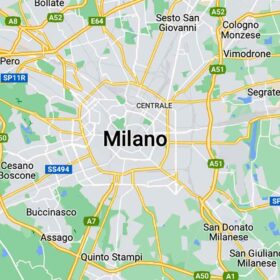
 The Geographic Location of Milan – A Strategic Spot in the Heart of Europe
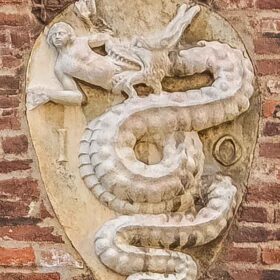 Milan’s coat of arms
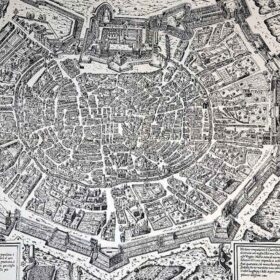 History of Milan
 Saint Ambrose
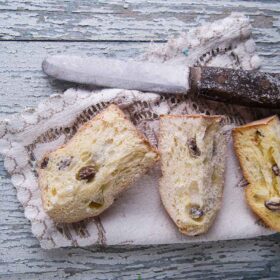 History of Panettone
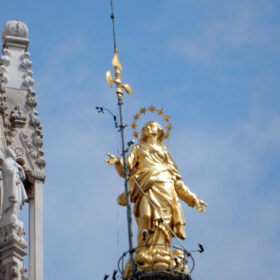 Madonnina
 City Hall
 Milanese cuisine


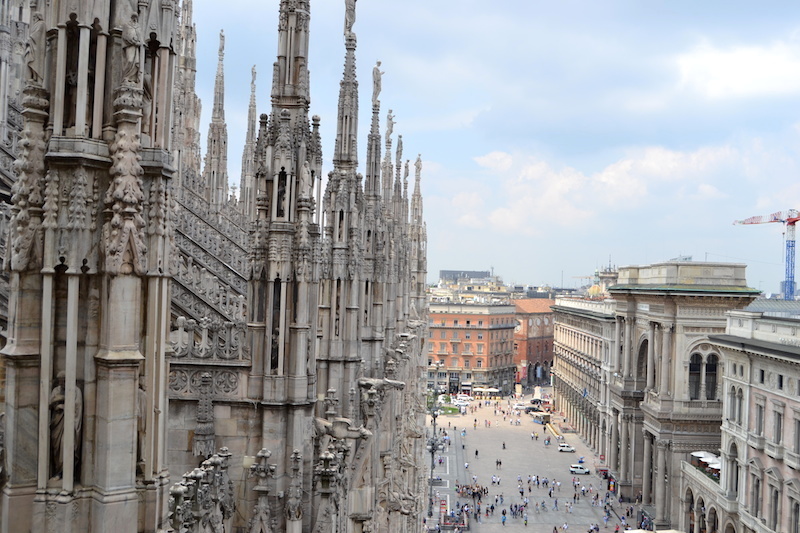
The history of the Duomo Cathedral in Milan began in 1386. Yet none of the architects who broke ground that year in Piazza del Duomo lived to see even half of it built. Their grandsons did not either. The history of Milan Cathedral stretches across 579 years, from 1386 to the symbolic year of 1965, through several generations of builders and at least five completely different architectural eras. The first blocks of marble were laid in the Gothic age, and the last elements of the facade were installed when humanity was already preparing to go to the Moon.
If you are planning a visit to the cathedral, take a look at the complete guide to the Duomo, where you will find information on tickets, opening hours, and visiting. Here, the focus is on what made this construction last longer than almost any other building in Europe.
Where did the cathedral come from? Milan before 1386
Two churches previously stood on the site of today’s Duomo: the Basilica of Santa Tecla, the summer cathedral, and Santa Maria Maggiore, the winter cathedral.
In the 4th century, Milan had a rather unusual arrangement: two cathedrals that served different liturgical functions depending on the season. Both stood in a place that had already been the city’s religious center since Roman times. Even earlier, according to some accounts, there had been a temple here dedicated to Minerva.
Both churches were destroyed and rebuilt many times. The critical moment came in 1386, when the bell tower of Santa Maria Maggiore collapsed, damaging part of the nave and the facade. Archbishop Antonio da Saluzzo then issued a bull, dated May 12, 1386, calling on the faithful to help finance the construction of a new, great cathedral. He encouraged donations, bequests, and free labor, and he promised 40 days of indulgence to those who supported the project.
The project only truly gained momentum because of someone else: Gian Galeazzo Visconti, ruler of Milan. Visconti had just overthrown his uncle Bernabò in a coup and unified the Visconti territories. He needed a gesture that would strengthen his position and show Milan, and all of Europe, that his state had ambitions to rival France or England. An enormous cathedral was meant to be that gesture.
Why was it built in marble rather than brick?
Visconti changed the original building plan from brick to marble from Candoglia, which completely transformed the scale and character of the cathedral.
The original project called for Lombard Gothic built in terracotta, in other words brick, a material typical of sacred architecture in Lombardy. The first construction engineer was Simone da Orsenigo, and it was he who oversaw the work carried out in that style.
But Visconti wanted something else. In 1389, he brought in the French architect Nicolas de Bonaventure and imposed both a change of material to marble and a shift in style toward Flamboyant Gothic (gotico fiammeggiante), inspired by the cathedrals north of the Alps. Much of what had already been built in brick was dismantled.
The marble came from the quarries of Candoglia, in the Val d’Ossola valley along the Toce River. Visconti assigned them to the cathedral project and made sure the transport of the material would be exempt from tolls and duties. Every block meant for the Duomo was marked with the stamp AUF (ad usum Fabricae, meaning “for the use of the Fabbrica del Duomo”), which allowed it to pass without customs charges. The route ran down the Toce River to Lake Maggiore, then along the Ticino and through the Navigli canals all the way to the center of Milan. This system remained in use for many centuries.

Language curiosity: According to a local legend, the Italian phrase a ufo – meaning “for free” or “at someone else’s expense” – comes from the AUF stamp on the marble blocks for the cathedral. Barges marked with those letters passed through every customs checkpoint without charge, and people began to say something was a ufo when no payment was required. Manzoni used the expression in The Betrothed, and Collodi used it in Pinocchio. Linguists still debate the real etymology, with some pointing to the Germanic ufjô, but the Milanese legend is still alive today.
In October 1387, at Visconti’s initiative, the Veneranda Fabbrica del Duomo was established: the institution responsible for the construction, upkeep, and financing of the cathedral. The Fabbrica employed 300 people and operated like a separate enterprise. What matters most is that it still exists today and still oversees the conservation of the cathedral.
The 15th century: the great problem of the dome and Leonardo da Vinci’s advice
For more than one hundred years, architects could not solve the problem of the tiburio, the central structure above the crossing of the naves.
By the mid-15th century, construction had been moving along steadily. The apse, the transept, and the first bays of the nave had been completed. In 1418, Pope Martin V, returning from the Council of Constance, consecrated the main altar. The cathedral was already being used for liturgical purposes, although it was still far from finished.
The problem arose at the crossing of the naves, where the tiburio had to be built – a many-sided structure above the point where the main nave and the transept intersect. In Gothic cathedrals, this is one of the most important elements of the entire building because it transfers enormous loads onto the pillars. These structural issues were exactly what kept troubling successive generations of architects.
In 1487, the Sforzas, who had taken power after the Viscontis, decided to settle the matter by inviting some of the greatest experts of the age to Milan. Among them were Donato Bramante, who was then working on the tiburium of Santa Maria delle Grazie, Francesco di Giorgio Martini of Siena, Luca Fancelli, and Leonardo da Vinci.
Leonardo, who had arrived in Milan around 1482, approached the problem almost like a medical diagnosis. In the surviving notes in the Codex Atlanticus, he compared the cathedral to a sick body, writing: “The sick Duomo needs an architect-physician” (al malato Domo bisogna uno medico architetto). He prepared drawings and a wooden model, but his proposal was ultimately not accepted. It is possible that he himself withdrew from the project, absorbed by other commissions at the Sforza court.
Bramante, for his part, criticized the earlier proposals but did not offer a concrete solution of his own. In the end, the tiburio was built between 1490 and 1500 under the direction of Giovanni Antonio Amadeo and Gian Giacomo Dolcebuono, although it was the result of the work of several teams. Its details also show the influence of Giovannino de’ Grassi and Francesco Briosco. They drew on solutions rooted in the local building tradition – and those are the ones that survived.
It is also worth paying attention to the capitals of the 52 pillars inside the cathedral, designed by Giovannino de’ Grassi in 1393. Each takes the form of a canopy with niches containing statues of saints. This is one of the details that makes the Duomo unlike the typical cathedrals north of the Alps and gives it a distinctly Lombard character.
Charles Borromeo and the revolution inside the cathedral (16th century)
After the Council of Trent, Archbishop Charles Borromeo radically reshaped the interior of the cathedral, giving it the form we largely still see today.
Before that, however, things around the construction had become much more complicated in the early 16th century. The French invasion, the fall of Ludovico il Moro, the last of the Sforza line, and a long period of political instability caused the work to nearly come to a halt. Services were already being held in the cathedral, but the building itself still remained unfinished: several bays of the nave were missing, as were parts of the transept and, of course, the facade.
The impulse to resume work came from the Church. The Council of Trent (1545-1563) set new liturgical standards, and their implementation in Milan was taken up by the energetic Archbishop Charles Borromeo (Carlo Borromeo), who held office from 1564 to 1584.
Borromeo appointed Pellegrino Tibaldi, known as Pellegrini, as the cathedral’s chief architect. The decision stirred controversy because Tibaldi was not a member of the Fabbrica, and appointing him required a change in its statutes. Even so, Borromeo pushed the nomination through.
Tibaldi redesigned the presbytery in accordance with the requirements of the Tridentine reform: the Eucharist was meant to stand at the center of the faithful’s attention. A new spatial layout was created, with a crypt, new side altars, and a baptismal font. The tombs of the Viscontis were also removed from the cathedral, and their later fate is still not entirely known. The floor was replaced with a marble pavement.
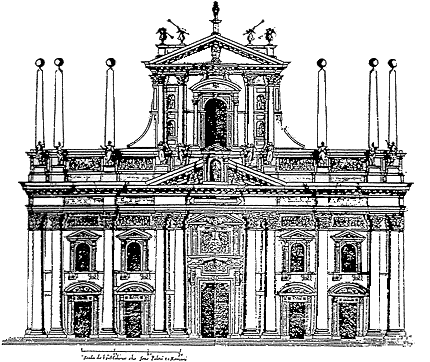
Tibaldi also designed a facade modeled on Roman architecture, with columns and a pediment, in order to emphasize the cathedral’s more Italian than Gothic character. Work began, but after Borromeo’s death in 1584 it clearly slowed down, and the facade remained unfinished for the next two centuries. Later modifications weakened Tibaldi’s original design.
The 18th century: the spire and the Madonnina
In 1774, the gilded Madonnina was placed on top of the newly built spire, and it remains one of Milan’s most important symbols to this day.
For most of the 17th century, the cathedral still stood with an unfinished facade and without its main spire. Work moved slowly: in 1628 the central portal was completed, and later more decorative elements in the Baroque style were added to the facade, though still without a coherent plan.
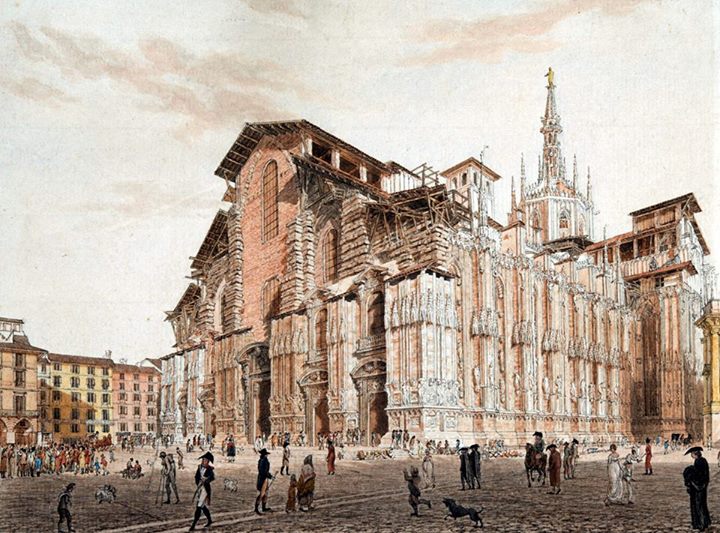
The breakthrough came in the second half of the 18th century. On the orders of Archbishop Giuseppe Pozzobonelli, the Veneranda Fabbrica decided in July 1765 to build the guglia maggiore, the main spire above the tiburio. The project was entrusted to Francesco Croce, one of the Fabbrica’s architects. Croce was not the most famous architect of his time, but he knew how to get things done. In spite of criticism and concerns about the stability of the structure, in just four years, from 1765 to 1769, he raised an elegant openwork spire.
It was Croce who proposed crowning the spire with a statue of the Assumption of the Virgin Mary. Giuseppe Perego won the competition for the sculpture. The figure, made of copper sheets covered in gold, stands 4.16 meters (13.6 feet) tall. It was installed on December 30, 1774. At that point, the cathedral reached its present height: 108.5 meters (356 feet).
From that point on, an unwritten but firmly respected rule took hold in Milan: no building should rise higher than the Madonnina. When the Pirelli skyscraper was built in the 1950s, at 127 meters (417 feet), a copy of the figure was placed on its roof. Today, such a replica stands on Palazzo Lombardia, which is 161 meters (528 feet) tall.
Napoleon, the facade, and the last great phase of construction (19th century)
Napoleon ordered the facade to be completed within a few years. Zanoia and Amati’s project was carried out by 1813, but the facade still clearly combines elements from different eras and styles.
On May 26, 1805, Napoleon Bonaparte crowned himself King of Italy in the cathedral, using the legendary Iron Crown of Lombardy. The Duomo still did not have a finished facade, and for Napoleon that was unacceptable.
By decree of May 20, 1805, he ordered the Veneranda Fabbrica to complete the facade. To finance the work, he ordered the sale of all the real estate belonging to the Fabbrica and promised that France would repay the costs incurred – something that, as some still like to point out, never actually happened.
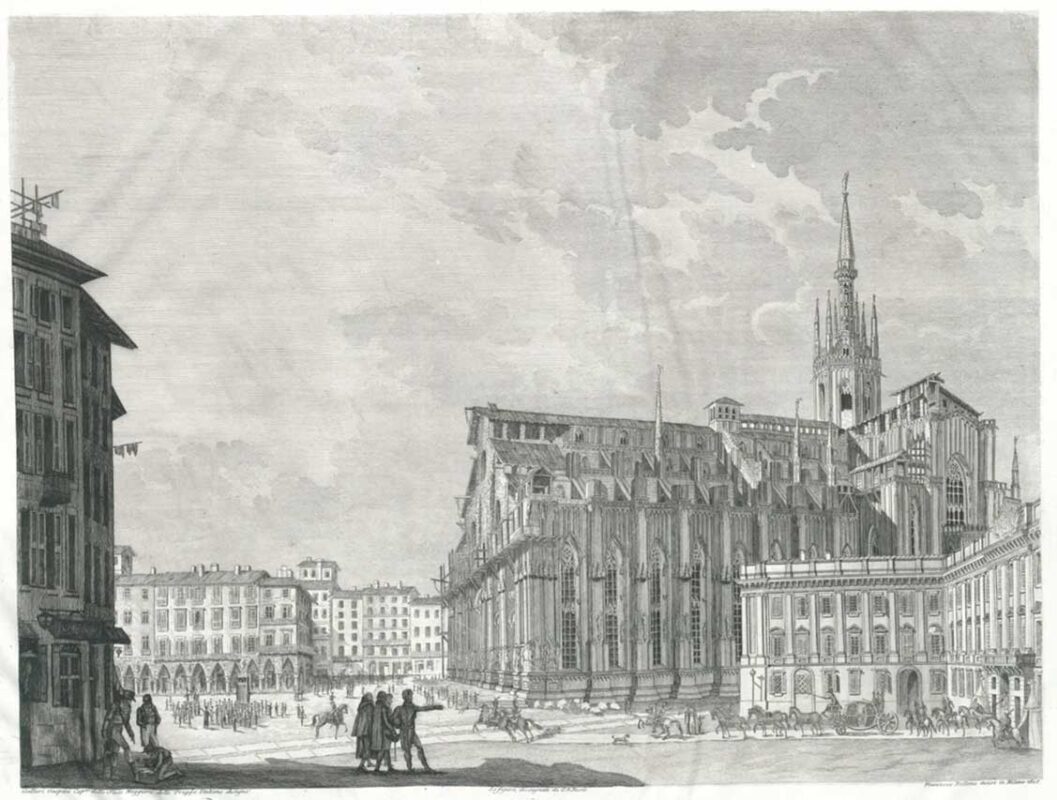
The completion project was entrusted to the architects Giuseppe Zanoia and Carlo Amati. Work lasted from 1807 to 1813, and the final phase dragged into the following year. The facade received a Neo-Gothic shape, but it was built on top of existing 17th- and 18th-century elements: Baroque portals, Mannerist windows, and Renaissance details. You can still see it today – the lower and upper parts of the facade clearly come from different periods and represent different styles.
In the following decades of the 19th century, the work focused on spires and sculptural decoration. During that time, around 1,800 new statues were placed on the cathedral. In 1866, the bell tower was dismantled and the bells were moved inside the tiburio.
The unfinished facade overhaul
In 1886, the Veneranda Fabbrica launched an international competition for a new, complete design of the facade in a coherent Gothic style. 120 projects were submitted from around the world. In 1888, Giuseppe Brentano won – a 26-year-old graduate of the Polytechnic University of Milan and a student of Camillo Boito. His design, inspired by French Gothic cathedrals, received the highest marks from the jury.
Brentano began work right away. Marble was ordered and scaffolding was set up. But on December 31, 1889, at just 27 years old, the architect died unexpectedly. At that point the project stalled, and over time the debates over whether the existing Baroque portals should be dismantled ultimately killed any chance of carrying it out. The facade therefore remained in the form we see today. Only one element from Brentano’s project was actually realized: the central bronze door by Ludovico Pogliaghi.
Brentano’s projects and models can be seen at the Cathedral Museum (Museo del Duomo), in the room devoted to his design.
1965 – the last doors and the symbolic end of construction
On January 6, 1965, the fifth and final bronze door on the facade was unveiled. That is the moment generally taken as the symbolic closing of the cathedral’s 579 years of construction.
The five bronze doors of the facade were created over more than half a century:
|
Door |
Artist |
Year |
|---|---|---|
|
1st from the left |
Arrigo Minerbi |
1948 |
|
2nd from the left |
Giannino Castiglioni |
1950 |
|
3rd center |
Ludovico Pogliaghi |
1906 |
|
2nd from the right |
Franco Lombardi / Virginio Pessina |
1950 |
|
1st from the right |
Luciano Minguzzi |
1965 |
The fifth door, made by the Bolognese sculptor Luciano Minguzzi, depicts 12 scenes from the history of the cathedral, from its foundation to the age of Charles Borromeo. Its inauguration took place on January 6, 1965, and that is the date conventionally accepted as the symbolic end of construction.
But what does “end” actually mean here? A cathedral built of marble from Candoglia requires constant conservation. Pollution, weather conditions, and the vibrations of the city mean that the stone is continuously deteriorating. The Veneranda Fabbrica has been carrying out restoration work without interruption since the 14th century, and everything suggests it will continue to do so. In that sense, the building of the Duomo never truly ends.
The most important dates in the history of the Duomo
|
Year |
Event |
Who was responsible |
|---|---|---|
|
1386 |
Start of construction of the cathedral |
Antonio da Saluzzo, Gian Galeazzo Visconti |
|
1387 |
Establishment of the Veneranda Fabbrica del Duomo |
Gian Galeazzo Visconti |
|
1389 |
Shift of the project toward mature Gothic and broader use of marble from Candoglia |
Nicolas de Bonaventure |
|
1393 |
Design of the pillar capitals |
Giovannino de’ Grassi |
|
1418 |
Consecration of the high altar |
Pope Martin V |
|
1487-1488 |
Competition and consultations concerning the tiburio |
Leonardo da Vinci, Donato Bramante, Francesco di Giorgio Martini |
|
1490-1500 |
Construction of the tiburio |
Giovanni Antonio Amadeo, Gian Giacomo Dolcebuono |
|
1564-1584 |
Interior reform after the Council of Trent |
Charles Borromeo, Pellegrino Tibaldi |
|
about 1590 |
Beginning of work on the new facade based on Tibaldi’s design |
Pellegrino Tibaldi |
|
1765-1769 |
Construction of the Guglia Maggiore (main spire) |
Francesco Croce |
|
1774 |
Installation of the Madonnina on the Guglia Maggiore |
Giuseppe Perego, Giuseppe Bini |
|
1805 |
Napoleon’s coronation in the cathedral |
Napoleon Bonaparte |
|
1807-1813 |
Completion of the present facade in its main outline |
Giuseppe Zanoia, Carlo Amati |
|
1886-1888 |
International competition for a new facade and Brentano’s winning project |
Giuseppe Brentano |
|
1906 |
Inauguration of the central bronze door |
Ludovico Pogliaghi |
|
1965 |
Inauguration of the fifth bronze door, conventionally regarded as the symbolic closing of construction |
Luciano Minguzzi |
Summary
The history of Milan Cathedral shows that the Duomo was never just an ordinary church. From the very beginning, it also reflected the city’s ambitions, money, disputes, and the decisions made by people from very different periods. The Viscontis, the Sforzas, Borromeo, Napoleon – each of them left some mark here. And later came restorations, corrections, and ongoing work, without which this structure would not have survived into our own time.
That is why the Duomo is not a uniform building. And maybe that is exactly why it leaves such a strong impression on visitors. The cathedral was not created in one style, in one century, or according to one vision. It is a building in which you can see centuries of changes, revisions, and different ideas about what it was supposed to be. Looking at it from the square, it is easy to see only the marble, the spires, and the Madonnina. But only when you know its history do you begin to notice that this is a building that was changed, expanded, and corrected over the course of centuries – and in a sense, still remains that way.
Sources:


I lived in Milan for 18 years, and it was there that I came to know the city’s daily life best - not just its landmarks, but also its rhythm, its habits, and its less obvious sides. Today I live in Wrocław, but I still return to Milan regularly.