


 The Geographic Location of Milan – A Strategic Spot in the Heart of Europe
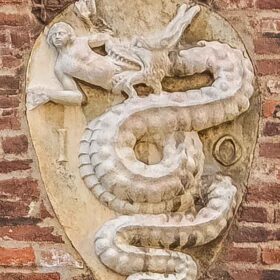 Milan’s coat of arms
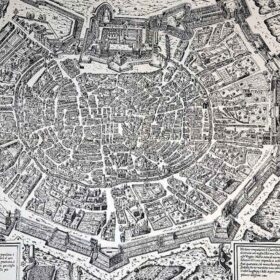 History of Milan
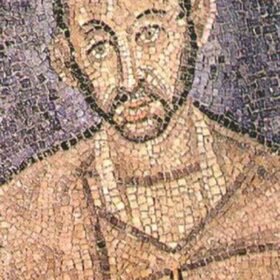 Saint Ambrose
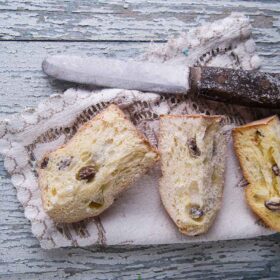 History of Panettone
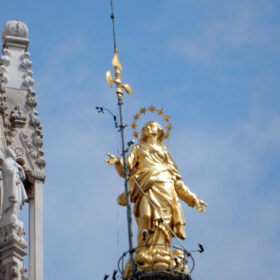 Madonnina
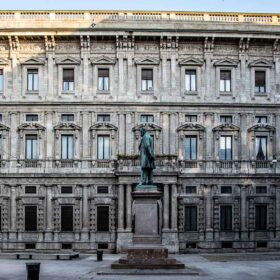 City Hall
 Milanese cuisine


Milan Cathedral completely stunned me when I saw it for the first time during a cool autumn evening. I remember as if it was yesterday – I walked out of the metro station by the Duomo, raised my head and just froze. That huge white building was literally breathtaking. Even now, when I go back there another time, I feel exactly the same – a mixture of awe and disbelief that something could be so impressive. Each time I discover new details, new perspectives. It’s worth the drive up to its roof – the view of the city from the cathedral’s terrace is amazing, and on sunny days you can even see the snow-capped peaks of the Alps. This is one of those places in Milan that you simply have to see with your own eyes.
Duomo di Milano: the majestic Cathedral of the Birth of St. Mary in Milan
Milan’s main cathedral, known as the Duomo di Milano or the Cathedral of the Birth of St. Mary in Milan (Italian: Santa Maria Nascente di Milano), is an iconic symbol of the city. Built of glistening Candogli marble, its construction began in 1386 and continued until 1966, a testament to its monumental character and historical significance. This impressive structure, with more than 3,400 sculptures and exquisite stained glass windows, is an outstanding example of Gothic architecture in Italy, distinguished by its unique combination of northern influences with elements typical of Lombardy.
Cathedral facade
The facade of the cathedral in Piazza del Duomo, with its classical windows and neo-Gothic crown, is a true architectural masterpiece. The interior of this temple, especially the chancel, which was restored in the second half of the 16th century, deserves special attention. Atop the apse vault, which is part of this unique structure, is an extremely valuable relic – the Holy Nail of the Cross.
Outside, the huge edifice of the cathedral is crowned by a soaring turret, which houses the famous statue of the Virgin Mary (Madonnina), made of gilded copper, 4 meters high, and dated 1774. For those who want to deepen their knowledge of this remarkable monument, the Museum del Duomo offers a rich exhibition related to the history and art of the cathedral.
The Terrace of the Duomo Cathedral
Na dach katedry w Mediolanie możesz dostać się na dwa sposoby – albo wejść po schodach (251 stopni), albo wjechać windą. Jeśli nie masz problemu z kondycją, polecam schody – są tańsze, a przy okazji zobaczysz z bliska niesamowitą architekturę katedry. The elevator is more convenient and will work great for elderly people or families with small children.
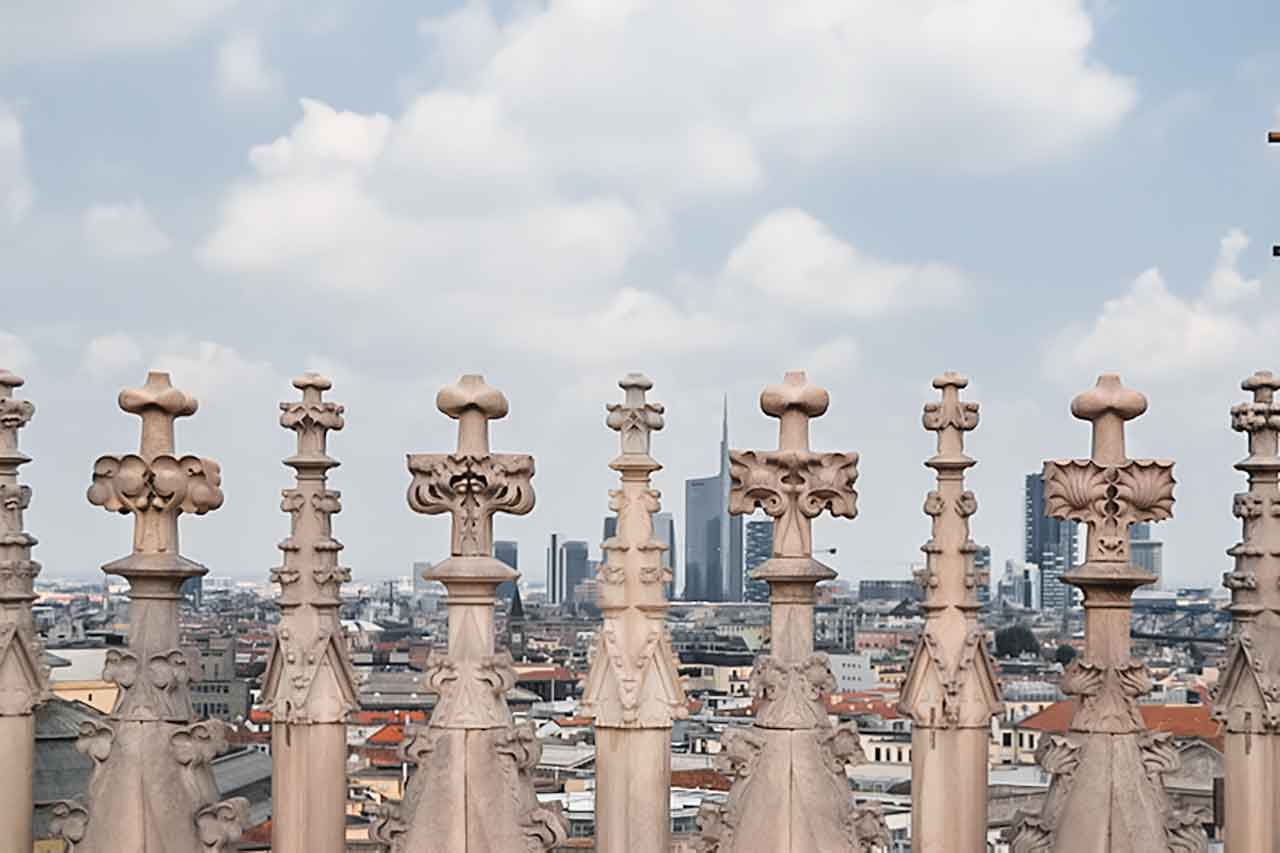
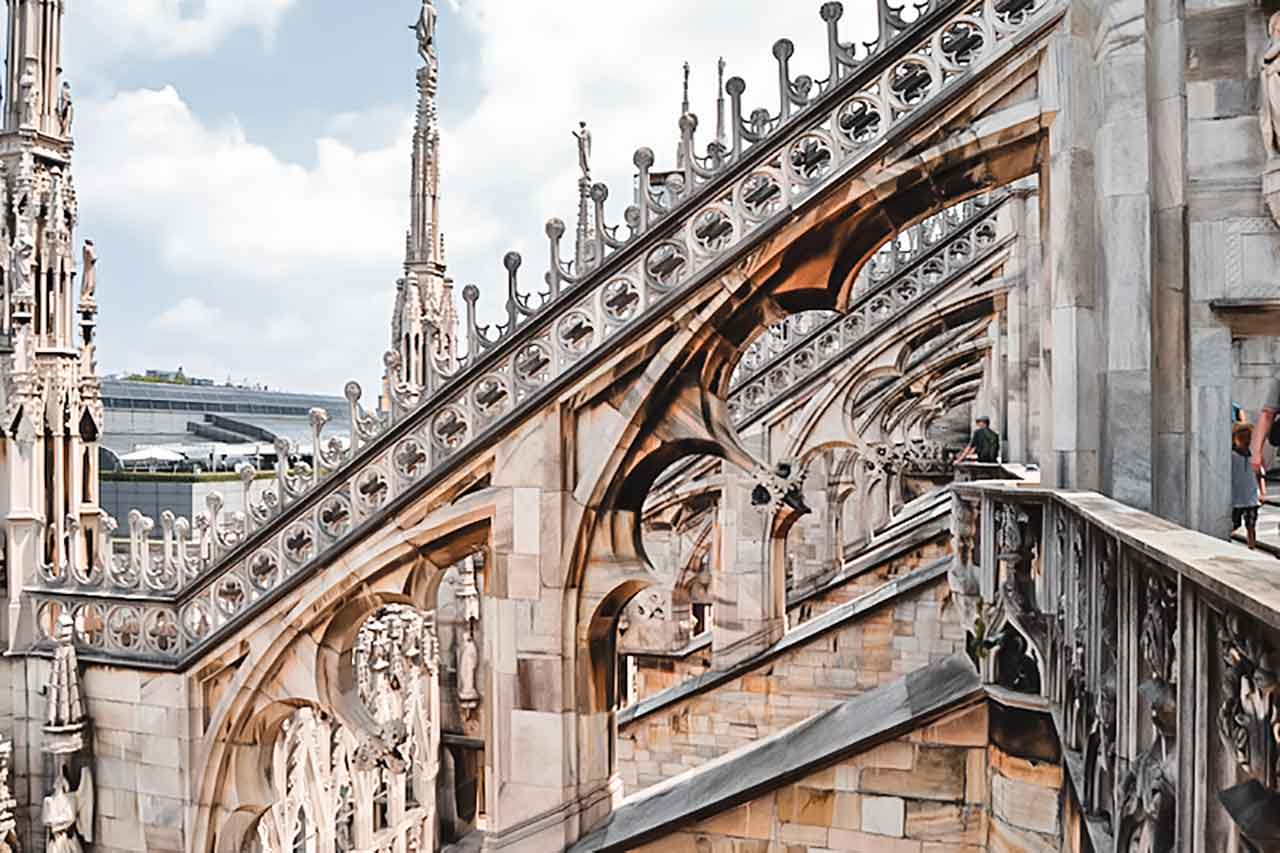
Once you reach the top, you’ll be greeted by a remarkable panorama that winds between the spires and allows you to approach the famous Madonna, located at 108.50 meters and 4.16 meters high, which has protected the city of Milan since 1774.
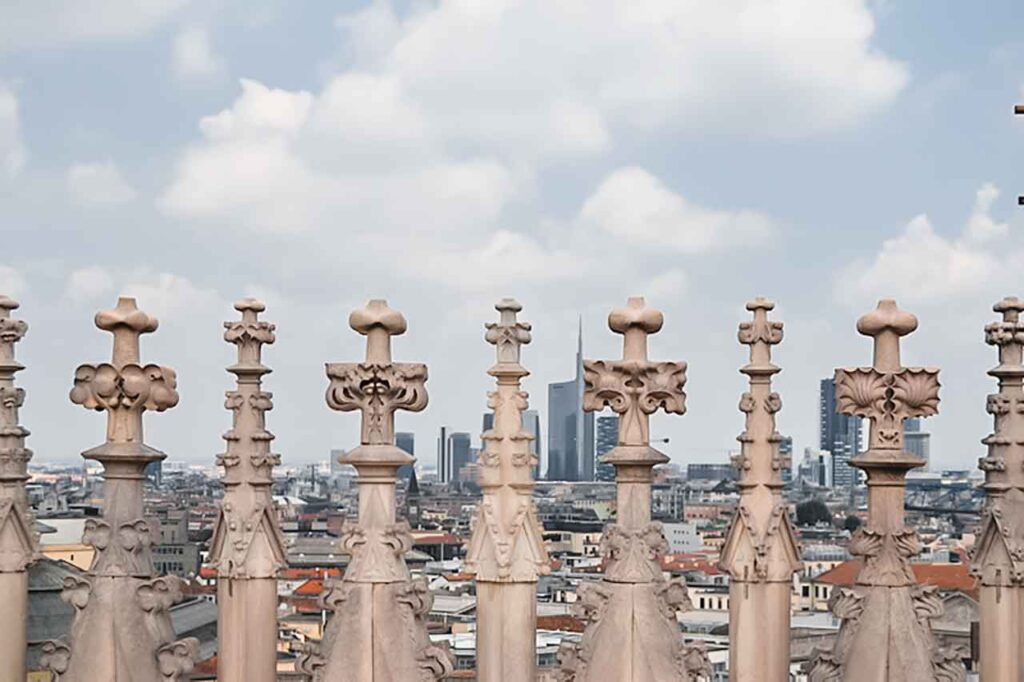
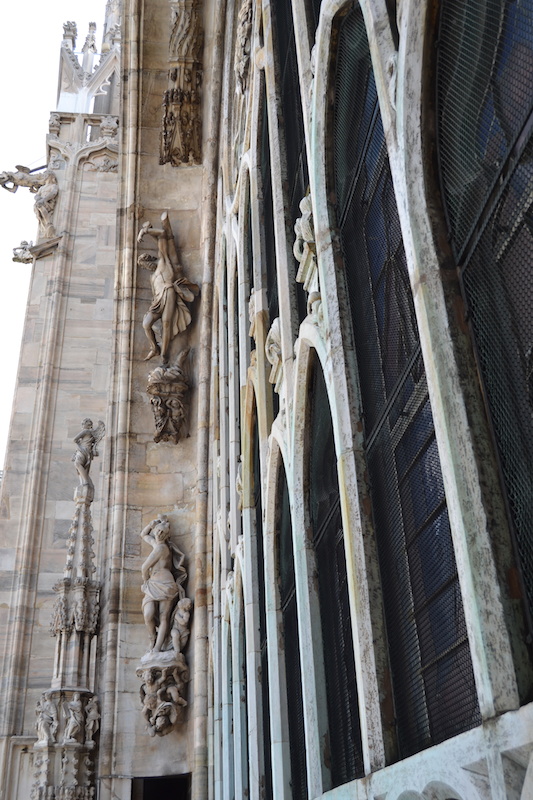
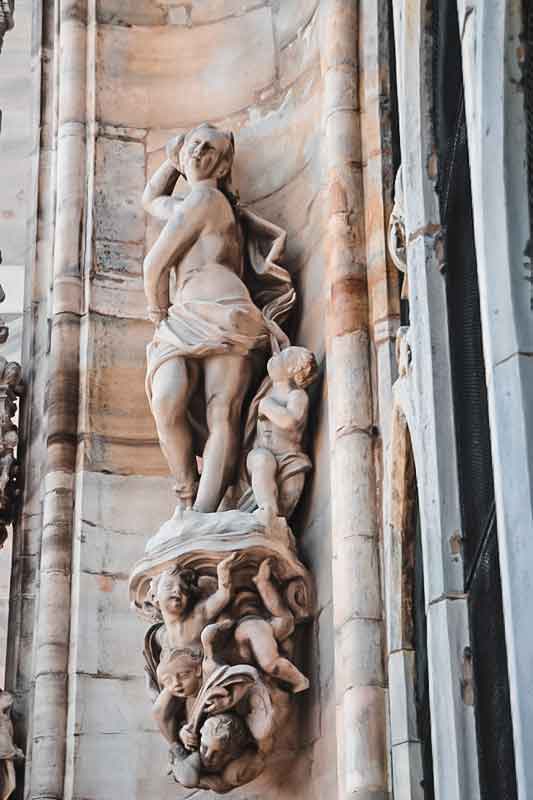
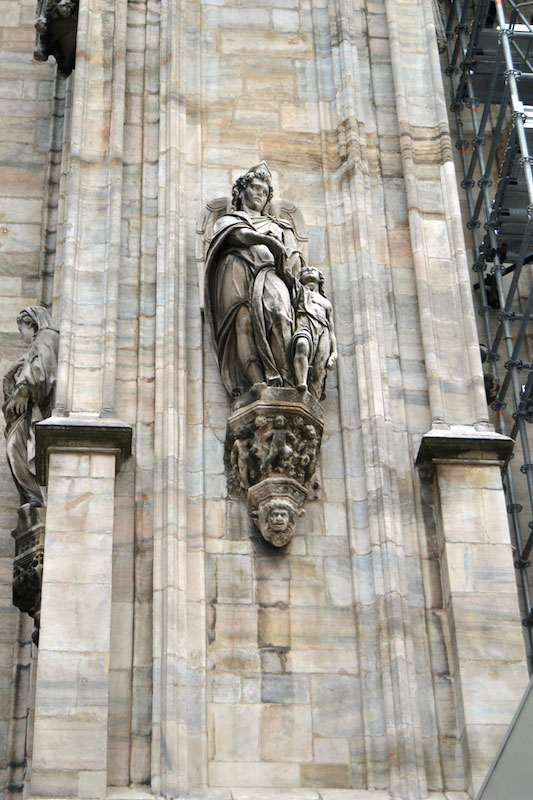
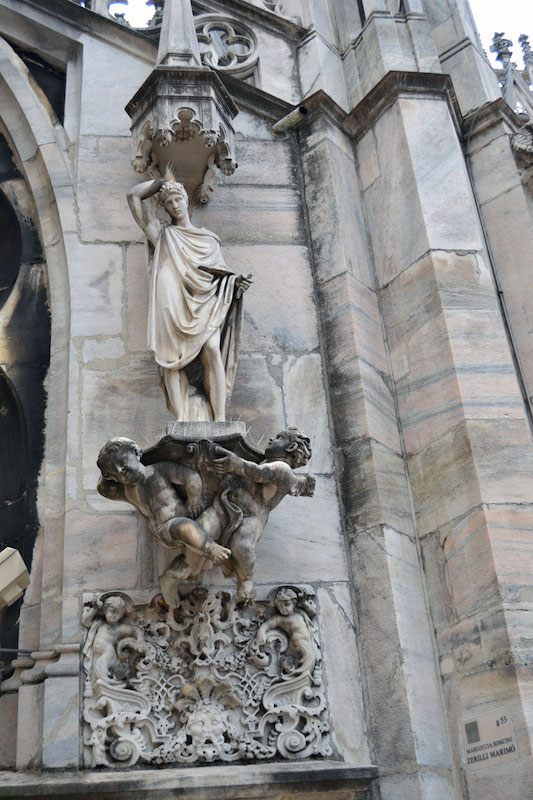
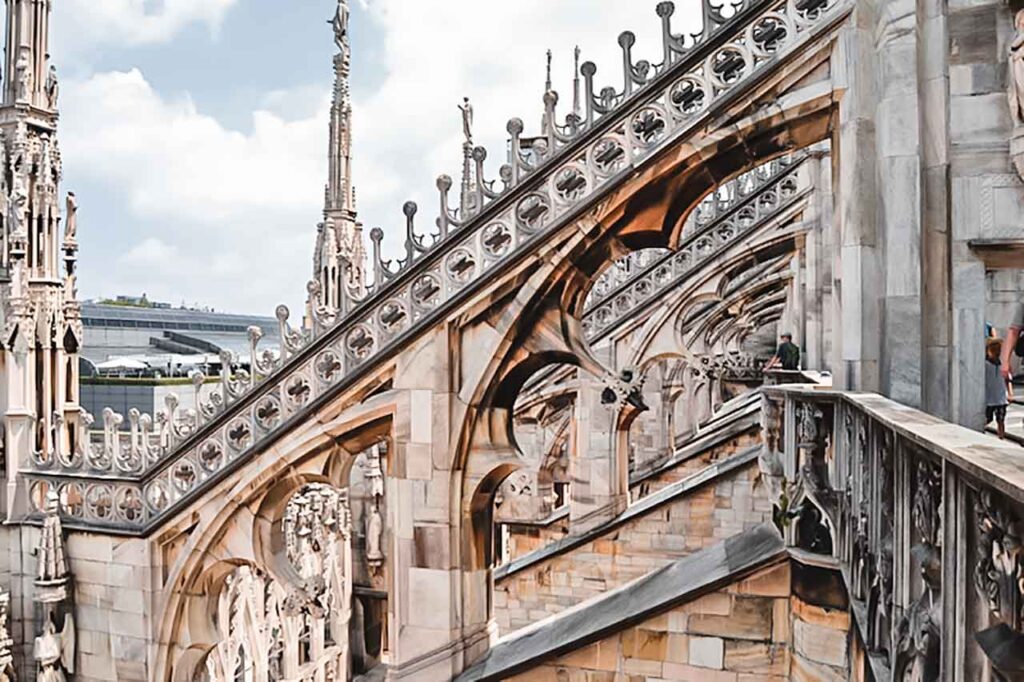
The terraces extend over 8,000 square meters and offer close-up views of the spires, pinnacles, arches and numerous statues that adorn the Duomo.
The Madonnina del Duomo, the church’s highest point, is the patron saint of Milan and, despite ancient traditions, has been surpassed in height by modern buildings such as the Pirelli skyscraper.
From the cathedral’s terraces you can enjoy a great view of all of Milan. On sunny days you can even see the snow-capped peaks of the Alps and the surrounding Po Valley from here. It is decorated with 135 ornate spires and more than 3,400 statues, creating a veritable forest of stone rich in decorative elements carved from Candoglia marble.



Inside the Duomo di Milano Cathedral – what to pay special attention to?
The interior of Milan’s cathedral is very impressive. This church is the largest Gothic building in Italy and there really is something to admire. From the very bottom, where there are old crypts, to the very top with vaults – there is something interesting hidden everywhere. It’s worth taking the time to explore thoroughly, as every element of the cathedral has its own history and significance.
Tomb of Charles Borromeo
“Scurolo di San Carlo” in the Duomo Cathedral in Milan is a truly unique place! It was designed in 1606 by Francesco Maria Richini. The name “scurolo” comes from the word “scuroeu” in the Milanese dialect, which means a dimly lit space. This small octagonal room is located just below the chancel of the cathedral, next to the crypt. It was specially completed and decorated for the canonization of Saint Charles Borromeo, which took place on November 1, 1610. This place is truly unique and worth a visit!
It is separated from the main chapel by a classical entrance. Inside is a unique urn made of crystal and silver – a gift from Spanish King Philip IV, designed by Cerano.The interior is decorated with marble mirrors in the lower part and 19th-century fabrics above. These fabrics were later enhanced with elaborate embroideries of silk and gold and silver threads. The designs allude to Eucharistic symbolism and the Borromeo family.
The Sack of Judgment Day
Inside the cathedral itself, along the right nave, near the entrance, one can find an unusual and mysterious object – a huge sack made of thick jute material, suspended high from the ceiling. What’s inside? This mystery is surrounded by legends and mysticism. According to the story, this enigmatic bag will fall to earth only once – on the Day of Judgment. It’s fascinating how the additional element gives the cathedral an aura of mystery and arouses curiosity among visitors, forcing them to wonder about its true meaning and history.
Ottone Visconti’s sarcophagus
The sarcophagus of Ottone Visconti, located in the right nave of the cathedral in Milan, is a significant symbol of the city’s history and the prominent Visconti family. In this sarcophagus rests Ottone Visconti, the first member of the Visconti family to rule Milan. This sarcophagus is supported by two majestic columns made of Verona marble. Inside the sarcophagus are also the remains of his successor, Giovanni Visconti.
Initially, this sarcophagus was located in the destroyed cathedral of St. Tecla; it is now part of the archaeological area beneath the cathedral.
Sun clock
The sundial in Milan Cathedral, created in 1786 by astronomers at the Brera Observatory, is one of the first features that catches the eye upon entering the church. It is located on the floor near the main entrance.
It’s a simple but ingenious mechanism. There is a brass strip with zodiac signs on the floor, and a small hole in the right wall. When sunlight comes through it at noon, it falls exactly on the zodiac sign where the sun is currently. This way you can not only check the time, but also see what zodiac sign you are currently in.
Saint Bartholomew skinned
Milan Cathedral is home to a unique sculpture, “San Bartolomeo scorticato,” made by Marco d’Agrate in 1562. The statue depicts one of the twelve apostles of Jesus, Bartholomew, who was sentenced to death for his Christian faith.
The sculpture depicts Saint Bartholomew in a special way – he carries his own skin on his shoulders, a reference to his martyrdom. This way of depicting the saint became popular after Michelangelo used such a motif in his fresco in the Sistine Chapel.
D’Agrate did not focus on the spiritual dimension of the figure. Instead, he created a detailed study of the human body, which was typical of the Renaissance and its fascination with anatomy. There is an interesting note on the base of the sculpture – the artist jokingly warns not to confuse his work with that of the famous Greek sculptor Praxiteles.
Visiting the Duomo – practical information, opening hours and price list
To visit Milan’s famous cathedral, it is necessary to purchase a ticket. The most economical option is a single ticket, the price of which is 5 euros *.
There are also various sets of tickets, known as “passes,” which allow visitors to visit in various combinations.
How much do tickets to Milan Cathedral and the Duomo terraces cost?
To fully experience the richness and history of Milan Cathedral, consider purchasing one of the available “passes.” These specially prepared ticket sets offer a variety of tour combinations, allowing you to tailor your visit to your individual interests and needs. From the standard tour inside the cathedral to exploring the ancient baptisteries, to climbing to the roof and in to see the city skyline, each pass opens the door to unique experiences.
Below is a table of available options so you can easily choose the perfect pass for you.
| Ticket name | What it includes | Regular Price | Reduced Price | Opening Hours |
|---|---|---|---|---|
| Culture Pass Plus | Duomo, Archaeological Zone, Duomo Museum, San Gottardo Church, Exhibitions, Scurolo di San Carlo | €18 | €9 | Daily: 8 a.m. to 7 p.m., Museo del Duomo: 10 a.m. to 7 p.m., closed Wednesday |
| Cathedral Terraces Museum – Elevator | Duomo, Roof (elevator), Duomo Museum, San Gottardo Church, Exhibitions | €25 | €12.50 | Daily: 9:00 a.m. to 7:00 p.m. (last entry 6:10 p.m.), Museo del Duomo: 10:00 a.m. to 6:00 p.m., closed Wednesday |
| Cathedral Terraces Museum – Stairs | Duomo, Roof (on foot), Duomo Museum, San Gottardo Church, Exhibitions | €20 | €10 | Daily: 9:00 a.m. to 7:00 p.m. (last entry 6:10 p.m.), Museo del Duomo: 10:00 a.m. to 6:00 p.m., closed Wednesday |
| Ticket + Duomo Tour Fast Track Guided Tour | Duomo, Archaeological Zone, Roof (elevator), Duomo Museum, San Gottardo Church | €38 | From €22 | Depends on the date of the visit |
| Fast Track Pass with elevator entry | Quick access to the Roof (elevator), Duomo, Archaeological Zone, Duomo Museum, San Gottardo Church, Exhibitions | €32 | €16 | Daily: 9:00 a.m. to 7:00 p.m. (last entry 6:10 p.m.) |
| Fast Track Elevator – only entrance to the Roof | Quick access to the Roof (elevator) | €28 | €14 | Daily: 9:00 a.m. to 7:00 p.m. (last entry 6:10 p.m.) |
| Duomo + Museum | Duomo, Duomo Museum, San Gottardo Church | €12 | €6 | Daily: 8 a.m. to 7 p.m., Museo del Duomo: 10 a.m. to 7 p.m., closed Wednesday |
| Duomo Time Walk (Augmented Reality Experience) | Experience Augmented Reality in the Duomo and Archaeological Zone | €15 | – | Mon-Sat: 9:30 a.m.-3:30 p.m., Sun: 1:00 p.m.-3:00 p.m. |
| Duomo + Ambrosiana | Cathedral, Archaeological Zone, Roof (on foot), Duomo Museum, San Gottardo Church, Exhibitions, Pinacoteca Ambrosiana, Crypt of San Sepolcro | €35 | €25 | Duomo: 8:00 a.m. to 7:00 p.m., Museo del Duomo: 10:00 a.m. to 6:00 p.m. (closed Wednesday), Pinacoteca Ambrosiana and Cripta: 10:00 a.m. to 6:00 p.m. (closed Wednesday) |
| Roof – Elevator Entrance | Roof (elevator) | €17 | €8.50 | Daily: 9:00 a.m. to 7:00 p.m. (last entry 6:10 p.m.) |
| Terraces – Entrance on Foot | Roof (on foot) | €15 | €7.50 | Daily: 9:00 a.m. to 7:00 p.m. (last entry 6:10 p.m.) |
| Culture Pass | Duomo, Archaeological Zone, Duomo Museum, San Gottardo Church, Exhibitions | €15 | €7.50 | Daily: 8 a.m. to 7 p.m., Museo del Duomo: 10 a.m. to 7 p.m., closed Wednesday |
| Origins of the Duomo | Virtual Reality Experience at the Duomo Museum | €9 | – | Daily at San Gottardo in Corte, closed Wednesday |
Buy a ticket:
What is included in each ticket package (“pass”)
The Duomo Cathedral
Includes a tour of the interior of the cathedral, without access to specially designated areas.
Baptysterium San Giovanni alle Fonti
It is located inside the cathedral and is one of the first baptisteries in Milan. Its history dates back to the time when the cathedrals of Santa Maria Maggiore and Santa Tecla stood on the site of the current cathedral facade.
Crypt of St. Charles (Scurolo di San Carlo)
It is a scurolo, or dimly lit place, where the relics of Saint Charles Borromeo are kept.
Saint Stephen’s Baptistery
Its remains can be seen at the entrance to the roof of the cathedral (on the left from the front, accessible by elevator). It is the oldest sacred monument in Milan, discovered in 1899 under the north sacristy of the cathedral.
The rooftop of Milan’s cathedral
The rooftop of Milan’s cathedral is one of the most important points to visit while in the city. It is one of the most impressive architectural structures in the world and a symbol of Milan. Skipping a visit to the cathedral’s roof would be almost as inappropriate as not seeing the Eiffel Tower when visiting Paris.
Without a doubt, it is a place that delights and leaves unforgettable impressions. To get to the roof of the temple, you can make your way on foot, but an elevator ride to the roof is available for the more lazy.
Grande Museo del Duomo – Cathedral Museum
The cathedral museum is located in Palazzo Reale and consists of 27 rooms spread over an area of more than 2,000 square meters. It presents a surprisingly diverse heritage, from sculptures, stained glass, paintings, and tapestries to architectural models, dating from the 14th century to the present.
Church of St. Gotthard of Hildesheim (San Gottardo)
It is located right next to the Palazzo Reale and is only accessible from there. It was built as the Duke’s Chapel by Azzone Visconti in 1330 and completed in 1336. Initially dedicated to the Blessed Virgin, Azzone, later suffering from gout, changed the dedication to St. Joseph. Gotthard of Hildesheim, the patron saint of those affected by the disease. The church was designed by Francesco Pecorari of Cremona.
Interesting facts about the Duomo Cathedral in Milan:
Milan’s Duomo is one of the largest churches in the world
The Duomo di Milano is the fifth-largest church in the world. It is second only to St. Peter’s Basilica in Rome, the Basilica of Our Lady of Aparecida in Brazil, the Cathedral of St. John the Divine in New York and the Cathedral of Seville.
A nail from the cross of Christ
Above the apse of Milan Cathedral, there is a place marked with a red light where a nail is kept, which is believed to be part of Christ’s cross. Every year, on the Saturday before September 14, the Archbishop of Milan, as part of the Nivola Ceremony, using a cloud-like wooden elevator, retrieves the nail, allowing the faithful to contemplate it.
A huge number of figures and statues
It should be mentioned that the façade of this Gothic cathedral has an impressive number of statues, which exceed in number those found on any other building in the world. The entire structure is decorated with an impressive 3,400 statues, 135 gargoyles, and 700 figures, making it extremely rich in sculptural elements.
Largest organ in Italy
The organ in the Duomo is the largest in Italy, and with its 15,800 pipes ranks second in Europe for the number of pipes and registers. The tallest pipe measures more than nine meters, while the smallest measures just a few centimeters.
Statue of Liberty
On the facade of the cathedral, just above the main entrance, is a statue that resembles the famous Statue of Liberty by Frédéric Auguste Bartholdi, donated by France to the United States in 1876. More on this in a post on the Statue of Liberty.
Carlina’s ghost
The ghost of Carlina, a young woman who suddenly disappeared between the building’s spires, is said to inhabit the interior of the cathedral. Since her disappearance, it is said that her ghost can be seen in some photos of the newlyweds. Fortunately, this is seen as a good omen.
History of the Milan Cathedral
The construction of the cathedral began in 1386 at the initiative of Archbishop Antonio da Saluzzo and Duke Gian Galeazzo Visconti. The main material was white marble from Candoglia, transported by canals to Milan. Construction lasted almost 600 years – the last bronze doors were installed in 1965. Napoleon crowned himself here as King of Italy in 1805 and ordered the façade to be completed.
FAQ
Is it possible to enter the cathedral in Milan for free?
Entrance to the cathedral in Milan is free for the faithful through a special entrance, which allows visiting the interior without charge. However, for tourists who want to use additional attractions, such as the rooftop terrace or museum, tickets are available, e.g., €8 for the basic tourist entry.
How much does it cost to enter the cathedral in Milan?
Entrance to the cathedral roof costs from 15 to 38 euros depending on the chosen version of the ticket. Check prices here.
How many stairs are there in the cathedral in Milan?
To reach the rooftop terrace, you can climb 256 stairs.
Who is on the top of the cathedral in Milan?
At the highest peak of the cathedral, there is a statue of the Madonnina, depicting the Blessed Virgin Mary, made of gilded copper, with a height of 416 cm
When was the cathedral in Milan built?
The construction of the cathedral began in 1386 and lasted for over 500 years, with the final details completed in 1965.
Is it allowed to wear shorts in the cathedral in Milan?
Entering the cathedral in shorts is prohibited.
How to dress for the cathedral in Milan?
There is a strict dress code in the cathedral: you must wear clothes that cover your knees and shoulders, such as long trousers, knee-length skirts, and blouses with sleeves. It is advisable to have a scarf with you to cover your shoulders if necessary.
What cannot be brought into the cathedral in Milan?
You are not allowed to bring large handbags, backpacks, or suitcases into the cathedral. You can leave them at nearby storage points, for example those offered by Radical Storage, which makes sightseeing easier.
Is the cathedral in Milan the largest in the world?
Nie, największą katedrą na świecie pod względem powierzchni wewnętrznej jest Katedra Metropolitalna Matki Bożej w Brasílii w Brazylii. Duomo di Milano jest natomiast największą gotycką katedrą na świecie.
I lived in Milan for 18 years, and it was there that I came to know the city’s daily life best - not just its landmarks, but also its rhythm, its habits, and its less obvious sides. Today I live in Wrocław, but I still return to Milan regularly.