


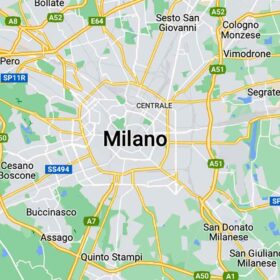
 The Geographic Location of Milan – A Strategic Spot in the Heart of Europe
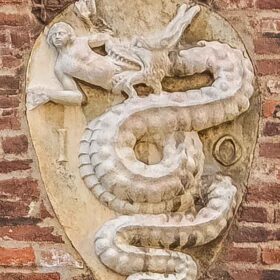 Milan’s coat of arms
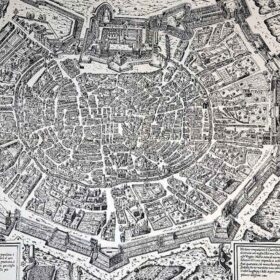 History of Milan
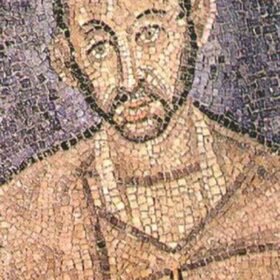 Saint Ambrose
 History of Panettone
 Madonnina
 City Hall
 Milanese cuisine


You’re strolling through the bustling Piazza del Duomo, admiring the monumental cathedral and snapping photos amid the crowd of tourists. Meanwhile, just a few dozen meters away, tucked between Milan’s modern streets, a true time machine awaits you. Piazza Mercanti – this small square, only 100 meters from the crowded Duomo – served as the actual heart of Milan for over five centuries. Today, tourists rarely venture here, yet it’s precisely this spot that preserves the finest examples of the city’s medieval architecture.
No crowds, no ticket lines. Just an authentic piece of Milan’s history, where time seems to flow differently.
What is Piazza Mercanti and where is it located?
Piazza Mercanti, or the Merchants’ Square
Piazza Mercanti (Merchants’ Square), also known as Piazza dei Mercanti, served as the heart of Milan from the 13th to the 18th century. Today, it’s a modest, small area, especially when compared to the monumental Piazza del Duomo, but in the Middle Ages, it occupied a much larger space and was the administrative, commercial, and judicial center of the city.
The square was established in 1228, given a regular, rectangular shape. Initially, it operated under the name “Piazza del Broletto,” derived from the main building “Broletto Nuovo” (New Broletto), which dominated the square. A distinctive feature of the 13th-century square was its six entrances, each leading to a zone associated with a different craft – where one could encounter makers of swords, hats, and other goods. This organization made Piazza Mercanti the economic hub of medieval Milan, a key location closely tied to trade and craftsmanship.
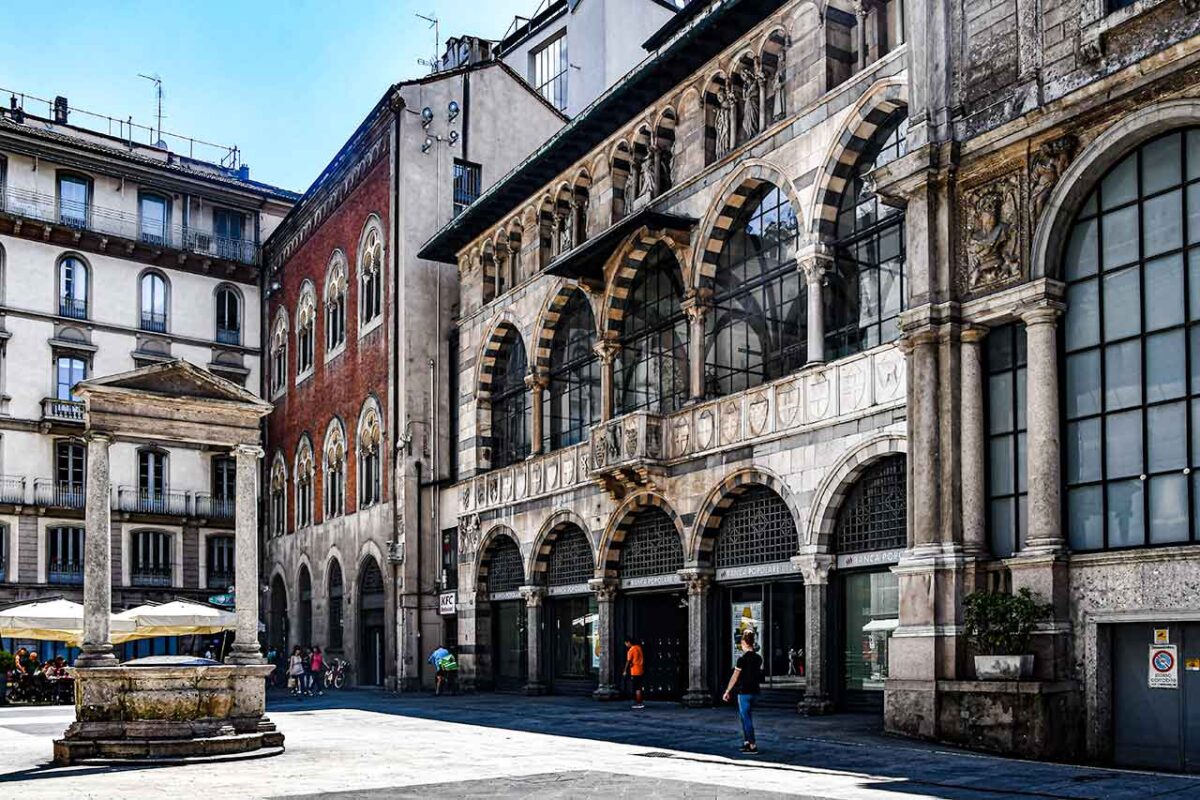
Today, the square preserves buildings from various eras – ranging from medieval and Gothic to Baroque. These diverse architectural styles, concentrated in a small space, attract history and architecture enthusiasts who value authenticity. Experts consider Piazza Mercanti the best-preserved fragment of medieval Milan, a place where you can see what the city truly looked like centuries ago, free from modern additions or alterations.
How to get to Piazza Mercanti – location and tips
Finding Piazza Mercanti can be tricky for tourists (surprisingly!), even though the square is located in the heart of the city. Nestled between two popular landmarks – Piazza del Duomo (with the cathedral) and Piazza Cordusio – it often goes unnoticed by those focused on the main attractions.
How to get to Piazza Mercanti from Piazza del Duomo:
Standing on the square with your back to the cathedral, find the street branching off to the right from the corner of the square toward Piazza Cordusio. This is essentially the beginning of Piazza Mercanti. As you continue, on your left, you’ll see a small square with a distinctive medieval building featuring arcades – this is the Palazzo della Ragione, the main structure of Piazza Mercanti.
If you want to reach it by public transport from other parts of Milan, use:
- Metro: The nearest stations are Duomo (lines M1 and M3) or Cordusio (line M1).
- Tram: Lines 2, 12, 14, 16, and 19 (stop at Via Orefici P.za Cordusio).
It’s worth noting that this square can easily be overlooked, especially when you’re following the crowd of tourists rushing to reach the castle as quickly as possible :). Piazza Mercanti is relatively small and partially separated from the main pedestrian traffic, making it one of the more intimate spots in the city center.
History of Piazza Mercanti
Medieval Milan and the Birth of the Square
The history of Piazza Mercanti dates back to the early 13th century, when Milan was a powerful, independent commune (city-state) in northern Italy. Its creation was tied to the need for a new administrative space for the growing city, which was emerging as one of the most significant metropolises of medieval Europe.
In 1228, during the rule of the podestà (mayor) Aliprando Fara of Brescia, the city council decided to build a new “broletto” (town hall) to replace the old one, which was located on land later occupied by the royal palace (Palazzo Reale). To create space for the new square, the city authorities purchased several houses from private owners and even the Lentasio monastery, which was relocated to the Porta Romana district.
Construction progressed remarkably quickly for the standards of that era, and by 1233, Podestà Oldrado da Tresseno of Lodi was able to complete the main building—a simple, functional structure. This building, named Palazzo della Ragione (Palace of Reason), became the central feature of the new square and shaped its further development, gradually attracting the headquarters of the city’s most important institutions.
In 1272, the roads leading to the square were paved, and Napoleone della Torre erected a tower on its northern side. Shortly afterward, a political upheaval occurred—Matteo Visconti expelled the Torriani family and seized control of the city. This event marked the beginning of the Visconti family’s centuries-long dominance over Milan, significantly influencing the city’s development and architecture.
The Role of the Square in City Life
For nearly five centuries, Piazza Mercanti served as the administrative, economic, and legal center of Milan. Its importance to the residents of the medieval city cannot be overstated—it was here that the entire public life of the community was concentrated.
Key Functions of the Square:
- Administrative Center – The Palazzo della Ragione hosted city council meetings where the most critical decisions regarding the city’s operations were made.
- Judicial Hub – The square was a place for issuing verdicts, announcing edicts, and decrees. From the balcony of the Loggia degli Osii, judges proclaimed sentences and important announcements. A notable feature of the justice system was the so-called “bankrupts’ stone” (pietra dei falliti), where those accused of bankruptcy or embezzlement were seated (naked) before their verdict was announced, subjecting them to public disgrace. Today, the stone is gone, replaced by a well.
- Commercial Center – In the 13th century, the square had six entrances, each tied to a specific craft. The names of the surrounding streets still reflect the trades once practiced there: Via Armorari (armorers), Via Spadari (sword makers), Via Cappellari (hat makers), Via Orefici (goldsmiths), Via Speronari (spur makers), and Via Fustagnari (weavers).
- Educational Center – The Palazzo delle Scuole Palatine housed the most important secondary school in medieval Milan, educating the city’s elite.
Interestingly, the arrangement of columns at the Palazzo della Ragione reportedly provided ideal acoustic conditions for confidential conversations, making it a popular spot for bankers to discreetly exchange important information.
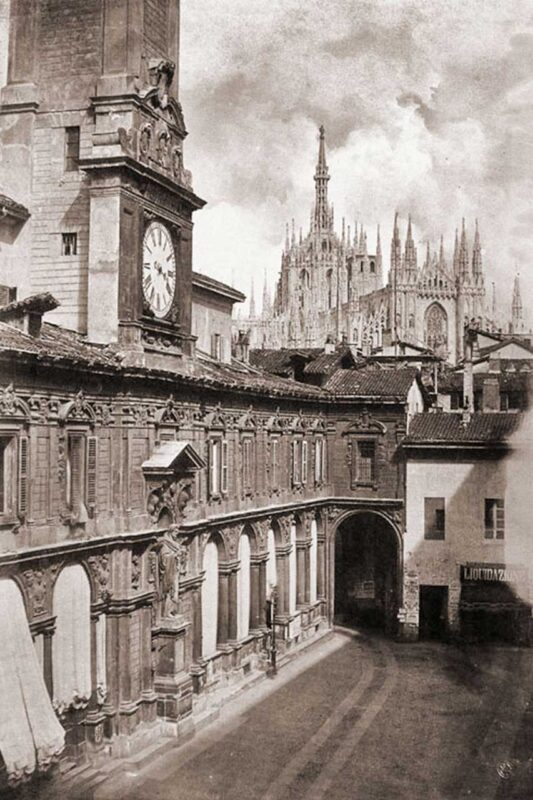
(now Via dei Mercanti)
Over time, the square underwent many changes. The most significant transformations occurred in the 19th century when the city authorities decided to improve urban transportation. At that time, a new street, Via dei Mercanti, was laid out along the northern side of the Palazzo della Ragione. Implementing this plan required demolishing some existing buildings and reconstructing others. As a result, the original spacious rectangular square was significantly reduced in size, losing its historic, cohesive character.
Until the end of the 19th century, Piazza Mercanti hosted the traditional“Oh bej! Oh bej!” fair, tied to the feast day of St. Ambrose, Milan’s patron saint, celebrated on December 7. This popular festival was a significant part of the city’s social and cultural life, drawing residents and merchants who filled the square with colorful stalls and a lively atmosphere. This tradition further reinforced the square’s importance as a place for gatherings and trade.
Architecture and Landmarks of Piazza Mercanti
Key Buildings and Their Functions
Piazza Mercanti is surrounded by five historic buildings that define its unique character and allow visitors to trace Milan’s architectural history from the Middle Ages to the 17th century.
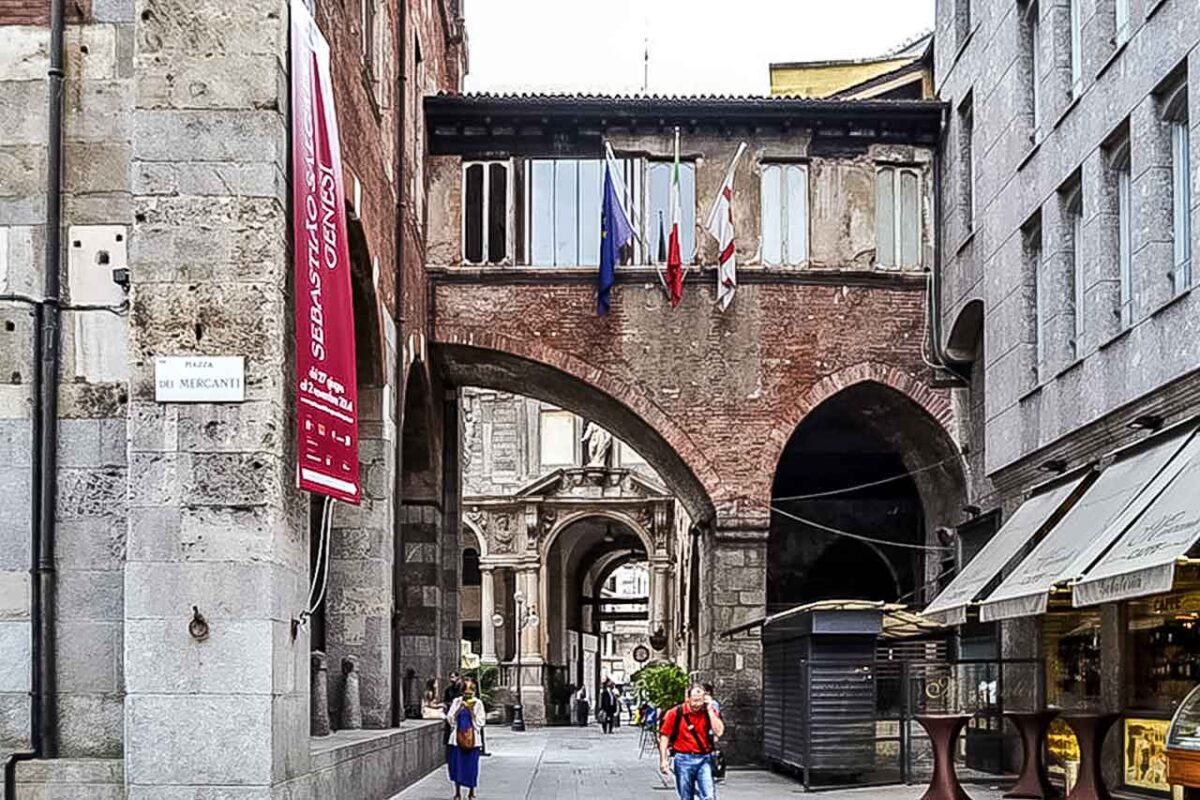
- Palazzo della Ragione (Broletto Nuovo) – The oldest and most significant building on the square, constructed between 1228 and 1233. This simple, brick rectangular structure originally served as the seat of the city authorities. Its distinctive feature is the lower level with arcades supported by stone pillars, above which lies a spacious hall measuring 50 × 18 meters, covered with roof trusses. The building was the main administrative hub of medieval Milan – citizen assemblies were held here, and the city’s most critical matters were resolved.
- Loggia degli Osii – A Gothic building erected between 1316 and 1321 on the orders of Matteo I Visconti, ruler of Milan. Its name derives from the Osio family, who owned palaces in the area before its construction. Designed by Scoto da San Gimignano, it was intended as a space for the city’s judicial and notarial activities. From its balcony (called the parlera), adorned with an eagle clutching prey (a symbol of justice), judges announced verdicts and edicts. An unusual feature for Milanese Gothic architecture is the black-and-white marble decoration on the façade, possibly a nod to Genoa and a tribute to Matteo Visconti’s wife, Valentina Doria.
- Palazzo delle Scuole Palatine (Palace of the Palatine School) – A Baroque building designed by Carlo Buzzi and built in 1645 on the site of earlier 14th-century Broletto Schools. It housed the most important secondary school in medieval Milan. The façade draws attention with its rich ornamentation, decorative elements, and masterful sculptures. Particularly striking are two notable statues: on the right, a figure of Ausonius, a 4th-century Roman poet who compared Milan’s grandeur to Rome in his works, and at the center, an impressive statue of St. Augustine.
- Palazzo dei Giureconsulti (Palace of Jurists) – Also known as Palazzo Affari, this Mannerist building was completed in 1652 during Spanish rule. From the outset, it served as the headquarters of the College of Noble Doctors, an institution established to train future politicians and lawyers.
- Casa dei Panigarola (Panigarola House) – Also known as the House of Notaries. In the Middle Ages, it housed the Statutory Office, which recorded and transcribed ducal decrees and public legal acts. The building played a key role in the city’s legal and administrative system, giving official status to private and state documents.
Architectural Details and Fun Facts
Piazza Mercanti hides many fascinating architectural details and curiosities that often escape the average tourist’s notice:
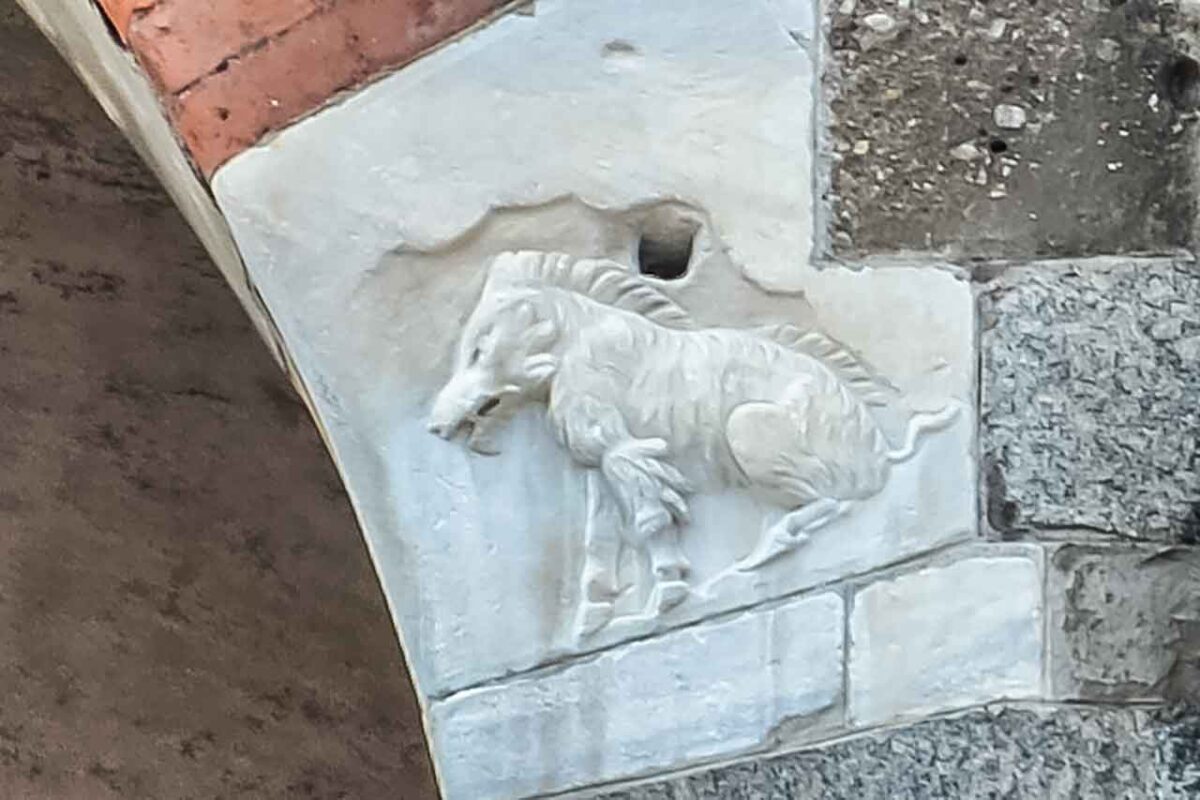
- Scrofa Semilanuta Relief – On the second arch of the Palazzo della Ragione, you can see a 4th-century AD relief depicting a half-woolly sow. This ancient element is one of the most significant symbols of Milan. Legend has it that the Celt Belloveso, while wandering through the Po Valley, saw a sow with distinctive long hair in a dream. Considering this animal a sign of prosperity and wealth, he decided to establish a settlement there called Mediolanum – a name formed as a play on words combining “semilanuta” (half-woolly) and “Medio-lanum.”
- 18th-Century Well – In the center of the square stands a well with 18th-century columns. It replaced the earlier-mentioned “bankrupts’ stone,” where insolvent debtors were judged.
- Details of Palazzo della Ragione – The building’s porticos and arcades are iconic. In the 18th century, under Maria Theresa of Austria, it was raised to accommodate a notarial archive, with the work overseen by architect Francesco Croce (designer of the Duomo’s tallest spire).
- Sculptures on Loggia degli Osii – Shortly after its completion, statues of the Virgin Mary with Child and Saints Stephen, Augustine, Lawrence, Denis, Catherine, John the Baptist, Peter, and Ambrose were carved by Ugo da Campione and his son Giovanni.
- Epigram on Palazzo delle Scuole Palatine – The façade features a Roman plaque belonging to the poet Magnus Ausonius. It bears an ancient epigram comparing 4th-century Milan to Rome, underscoring its significance and power at the time.
- Acoustic Properties of the Colonnades – Historical sources suggest that the column arrangement at Palazzo della Ragione created unique acoustic conditions, enabling discreet conversations. Bankers often used these spots for confidential negotiations, leveraging the architecture’s natural properties for privacy in a public space.
- Changes to the Square’s Appearance – The original Piazza Mercanti was much larger than it is today. In the 19th century, to improve traffic flow, Via dei Mercanti was created, requiring the demolition and reconstruction of parts of the square. The well, originally on the opposite side (now Via Mercanti), was moved first to Monastero Maggiore and then, in 1923, installed in its current location.
- Name Change During Fascism – Under Mussolini’s regime, the historic square was renamed Piazza Giovinezza (Youth Square), and the Scuole Palatine and Loggia degli Osii were occupied by the GUF (Gruppo Universitario Fascista), a fascist student organization.
What to See at Piazza Mercanti and Nearby?
Hidden Gems of the Square
Despite its small size, Piazza Mercanti offers plenty of interesting spots and details worth exploring:
- Interior of Palazzo della Ragione – Though not always open to visitors, temporary exhibitions are sometimes held here. Check local cultural listings to catch it when accessible. The main hall with its historic roof trusses is awe-inspiring.
- Scrofa Semilanuta Relief – This fascinating detail recalls the legendary origins of the city. A keen eye will spot it on the second arch of Palazzo della Ragione. It’s worth snapping a photo of this lesser-known city symbol.
- Historic Well – The central 18th-century well with columns has an intriguing past, once the site of the “bankrupts’ stone” for publicly shaming dishonest merchants.
- Loggia degli Osii Balcony – Take a closer look at the balcony where key city documents were announced. It’s adorned with an eagle clutching prey—a symbol of justice—and the Visconti family crest.
- Arcades of Palazzo della Ragione – stroll under the arcades to feel the atmosphere of a medieval city. Pay attention to the acoustics of this place – historically, it was used for conducting confidential business conversations.
- Details of the Palazzo delle Scuole Palatine Façade – The baroque façade of the building captivates with its wealth of decorations and details. It’s worth taking a close look not only at the famous statues of Ausonius and St. Augustine but also at the numerous reliefs, ornaments, and architectural elements that adorn the entire structure, testifying to the mastery of the artisans of that era.
- Photogenic Perspectives – The square offers great photo opportunities, especially in the morning or late afternoon when the light highlights the historic buildings’ details. Shots through the Palazzo della Ragione arcades are particularly atmospheric.
Nearby Attractions – Where to Stop Along the Way
Piazza Mercanti is an excellent starting point for exploring other Milanese treasures. Nearby highlights include:
- Piazza del Duomo and the Cathedral – Milan’s main square with its monumental Gothic cathedral (Duomo) is just a few minutes’ walk from Piazza Mercanti. A must-see on any Milan visit.
- Galleria Vittorio Emanuele II – Italy’s oldest active shopping gallery, with its iconic glass roof and mosaics. The entrance is at Piazza del Duomo.
- Teatro alla Scala – One of the world’s most famous opera houses, a short walk from Piazza Mercanti via Piazza Cordusio.
- Castello Sforzesco (Sforza Castle) – Heading from Piazza Mercanti down Via Dante (one of the city’s liveliest streets), you’ll reach this imposing red-brick castle, once home to the Sforza rulers of Milan.
- Pinakoteka Ambrozjańska – A museum and library about 3-4 minutes’ walk from the square, housing works by Leonardo da Vinci, Caravaggio, and other masters.
- San Maurizio al Monastero Maggiore – Often called “Milan’s Sistine Chapel” for its stunning frescoes, this church is a 10-15 minute walk away.
- Piazza Affari – Home to the controversial “L.O.V.E.” sculpture (a raised middle finger) and the Milan Stock Exchange, offering a modern art contrast to Piazza Mercanti’s history.
- Piazza Cordusio – An elegant square with 19th-century buildings and bank headquarters, showcasing Milan’s financial might from the early 20th century.
Practical Tips for Tourists
When’s the Best Time to Visit?
Piazza Mercanti can be visited year-round, but the best times are spring (April-June) and early autumn (September-October), when the weather is mild and there are fewer tourists. Morning hours (8:00-10:00) or late afternoon (5:00-7:00 PM) offer the best light for photography. Weekdays are quieter than weekends. Consider visiting on December 7, the feast day of the city’s patron saint, St. Ambrose, to experience Milan’s unique atmosphere. It’s better to avoid August, when temperatures are high and many local businesses are closed.
Note that Palazzo della Ragione is now primarily used for temporary exhibitions. If you want to see the interior, check Milan’s cultural event calendar to time your visit when it’s open to the public.
What to Know Before Visiting
Exploring Piazza Mercanti takes 30-45 minutes, though an hour is ideal if you want to examine the details closely. It’s a perfect stop on a route from the Duomo to Sforza Castle via Via Dante. Since there are few information boards, it’s wise to prepare beforehand or use a guide. While the square itself lacks dining options, you’ll find plenty along Via Dante and Piazza Cordusio. Photographers will love the arcade shots from Palazzo della Ragione. The square is safer and less crowded than the cathedral area, but standard big-city caution is advised. Those with limited mobility may find the cobblestone surface challenging.
Summary – Why Visit Piazza Mercanti?
Piazza Mercanti is a true hidden gem in the heart of Milan, revealing the city’s medieval face, which usually remains in the shadow of modern districts and heavily visited attractions.
Reasons to visit include: it’s the best-preserved slice of medieval Milan; it rarely sees tourist crowds; it packs diverse architectural styles into a small space; and its buildings hold fascinating historical details.
Begin your exploration of medieval Milan at Piazza Mercanti. From there, head to the 4th-century Basilica of Sant’Ambrogio, then to the Church of San Maurizio with its spectacular frescoes, and finally to the mighty Sforza Castle.
This route will show you a Milan you won’t see by sticking to the usual paths—a city of merchants, artisans, and artists who built its greatness over centuries. Just a brief detour from the road to the cathedral unveils the fascinating world of medieval Milan, with Piazza Mercanti as a perfect example.


I lived in Milan for 18 years, and it was there that I came to know the city’s daily life best - not just its landmarks, but also its rhythm, its habits, and its less obvious sides. Today I live in Wrocław, but I still return to Milan regularly.