


 The Geographic Location of Milan – A Strategic Spot in the Heart of Europe
 Milan’s coat of arms
 History of Milan
 Saint Ambrose
 History of Panettone
 Madonnina
 City Hall
 Milanese cuisine


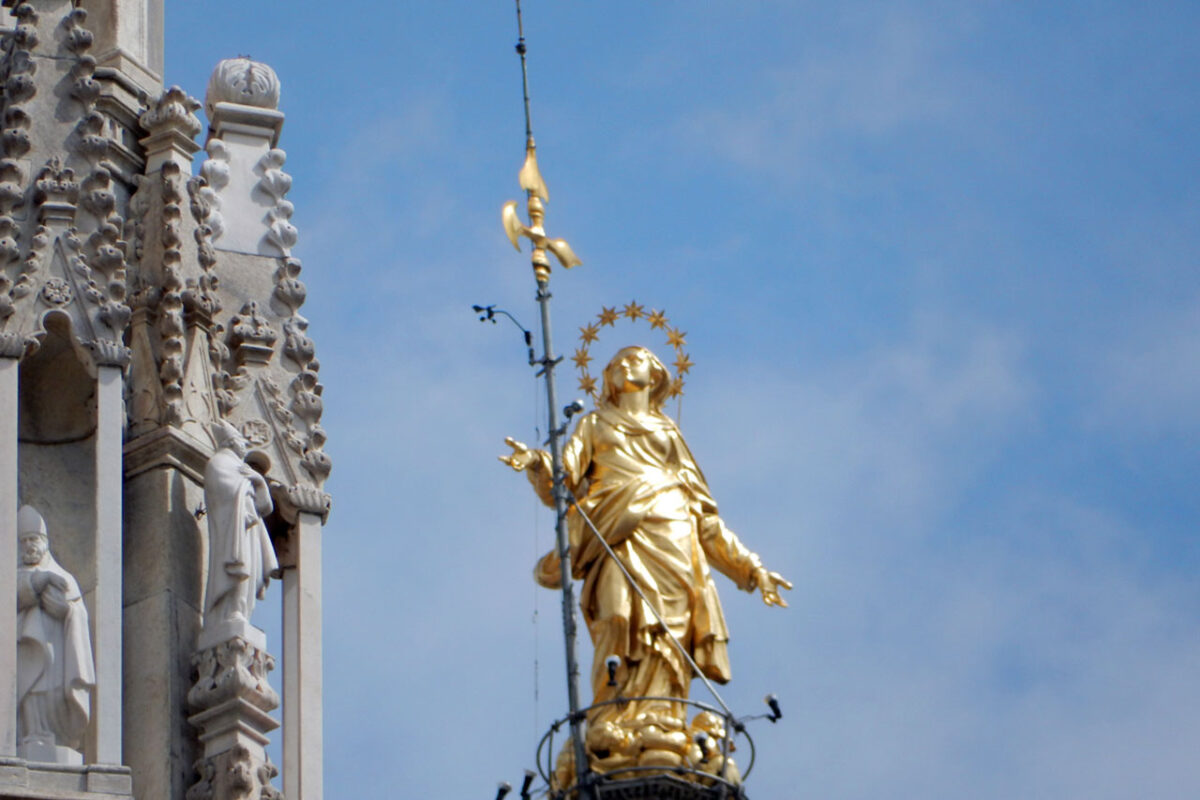
You come out of the metro at Piazza del Duomo, look up, and see a forest of spires. Somewhere at the very top, 108 meters above the square, gold catches the light. That is her – La Madonnina, the figure of the Virgin Mary that has stood on the cathedral’s highest spire since 1774 and has watched over the city through one era after another, from wars to the birth of modern Milan. She is worth knowing a little better before you stand beneath the Duomo and start counting spires.
Who is the Madonnina and why is she a symbol of Milan?
The Madonnina is a gilded statue of the Virgin Mary made of copper, standing 4.16 meters tall.
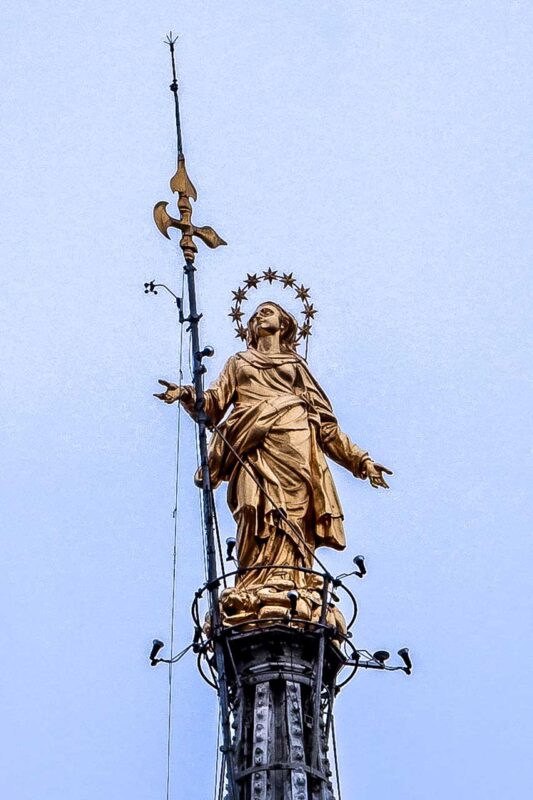
The word Madonnina is simply a diminutive of Madonna – the Virgin Mary. In Milan, though, that diminutive took on a very different weight. To say “Madonnina” in Milan is, in many ways, to say “Milan.” Expressions such as sotto la Madonnina (under the Madonnina) or all’ombra della Madonnina (in the shadow of the Madonnina) are local ways of referring to the city itself – for many residents, the Madonnina is simply shorthand for all of Milan.
The figure has long been considered one of the city’s most important symbols. She stands with open eyes and her arms raised upward, in a gesture of blessing over the city. For centuries, she was the highest point on the skyline – visible from many neighborhoods and helping residents find a familiar point on the horizon.
How the Madonnina was created and who made it
The figure was designed by the sculptor Giuseppe Perego, while the goldsmith Giuseppe Bini was responsible for its execution.
In the 18th century, the cathedral was still unfinished. The main spire was already there, but it still lacked the figure meant to crown it – even though the idea of placing one on the spire had existed since the very beginning of the cathedral’s construction, in 1386. It was not until Archbishop Giuseppe Pozzobonelli that someone finally decided to bring that chapter to a close. In 1765, the design work was entrusted to the architect Francesco Croce, who also oversaw the raising of the spire to its final height of 108.5 meters.
Two men worked on the figure itself: Perego was responsible for the sculpture, while Bini handled its gilded copper covering. The Madonnina weighs almost a ton and is made up of about 3,900 copper plates, each one covered in gold. Inside, there is a metal framework – without it, a figure of this size would not have survived on the spire for so many centuries.
The inauguration took place on December 30, 1774. The people of Milan welcomed it with enthusiasm – it quickly became something more than just an architectural feature of the cathedral.
The tradition of height: why could no building be taller?
For decades, Milan followed an informal rule: no building could rise higher than the Madonnina at 108.5 meters.
For a long time in Milan, attachment to the Madonnina went hand in hand with real limits on building height. Building regulations from the 1930s did in fact restrict the height of new buildings in central Milan, and one result was that nothing rose above the level of the Madonnina. Officially, the goal was to preserve a consistent skyline and, less romantically, to account for geology: a few meters beneath central Milan there is an aquifer. A heavier and taller building could have caused stability problems.
That rule could not last forever, though. Milan was growing economically, and the demand for offices and commercial space kept increasing. When new high-rises such as Torre Velasca began to be planned in the postwar years, the question of height became especially delicate. The solution turned out to be simple and very Milanese: if a building had to be taller, a copy of the Madonnina would be placed on top.
Copies of the Madonnina: where can you find them in Milan?
Several Milanese skyscrapers have smaller copies of the Madonnina on their rooftops – that was the condition for going beyond the symbolic height of 108.5 meters.
The first building to break the taboo was the Pirellone – the Pirelli skyscraper designed by Gio Ponti, completed in 1959 and standing 127 meters tall. To preserve tradition, a replica of the Madonnina was placed on its roof. The building is still the seat of the Lombardy regional government and remains one of the symbols of postwar Italian architecture.
In 2010, that specific replica was moved to a newer building – Palazzo Lombardia (161 m), the current headquarters of the Lombardy region. The Pirellone kept its own copy. The tradition is still alive: Allianz Tower (209 m), completed in 2015 and currently the tallest building in Milan, also has a copy of the golden figure on top.
The solution was simple: if a building was going to be taller, a copy of the Madonnina appeared on its roof. In Milan, the Madonnina is present not only as a symbol, but also as a real part of the city’s skyline.
Derby della Madonnina – how did the figure make its way onto the field?
Derby della Madonnina is the local name for the AC Milan – Inter Milan match, the biggest sporting event in the city and one of the most famous derby matches in soccer.
The name of the derby comes directly from the Madonnina as a symbol of Milan – both clubs represent the same city, and both play under the same golden patron figure. The very name of the derby shows how deeply the Madonnina has entered the city’s identity.
“O mia bela Madunina” – the song that became Milan’s unofficial anthem
The song “O mia bela Madunina,” written in 1935 by Giovanni D’Anzi, is one of the best-known pieces in the Milanese dialect and the city’s unofficial anthem.
The Milanese dialect (milanese) is clearly different from standard Italian – it is older and has its own grammar and vocabulary. D’Anzi’s song is written in that dialect, which is why the title is Madunina, not Madonnina. It is sung on many civic, sporting, and family occasions. Few songs capture attachment to the city so well.
Fragment tekstu z przekładem:
“O mia bela Madunina”
(MIL)
O mia bela Madunina, che te brilet de luntan
tüta dora e piscinina, ti te dominet Milan
sota ti se viv la vita, se sta mai coi man in man
canten tucch “luntan de Napoli se moeur”
ma poe vegnen chi a Milan(Giovanni D’Anzi)
(EN)
O my beautiful Madonnina, shining from afar,
all in gold and so small, you dominate over Milan.
Life flows in your shadow, never standing idly by,
everyone sings “far from Naples one dies,”
and then they come here to Milan.
The last part carries a note of irony: canten tucch “luntan de Napoli se moeur” – everyone sings that far from Naples you die, and yet they still come to Milan. It is a very Milanese kind of joke – a city known for hard work and winter fog presented as a magnet stronger than the sunshine of the south.
How to see the Madonnina up close?
You can go up to the roof of the Duomo by stairs (about 251 steps) or by elevator – from there, the figure is visible from a distance of just a few dozen meters.
From Piazza del Duomo, the Madonnina looks like a small golden point against the sky. Only once you reach the rooftop terraces, at about 45 meters high, does it begin to read as an actual figure. Seeing it from there, among the spires and pinnacles, gives you a real sense of scale: that “tiny” Madonnina from D’Anzi’s song is more than four meters tall.
Access to the Duomo terraces requires a separate ticket, independent of the ticket for the cathedral interior.
If you prefer to see the Madonnina from a distance, from a perspective other than the square in front of the cathedral, take a look at the list of the best terraces and viewpoints in Milan, where the Duomo appears in the background of many of them.
Facts about the Madonnina
For 250 years, the Madonnina has remained one of the strongest symbols of all Milan.
A few things worth remembering:
FAQ – frequently asked questions
Who created the Madonnina on the Duomo in Milan?
The figure was designed by the sculptor Giuseppe Perego, and the gilded copper cladding was created by the goldsmith Giuseppe Bini. The inauguration took place on December 30, 1774.
How many meters is the Madonnina?
The statue measures 4.16 meters in height. It stands on top of the main spire of the cathedral at a height of 108.5 meters above the level of Piazza del Duomo.
Why is the Madonnina a symbol of Milan?
Since 1774, it has been the highest and most recognizable element of the city’s skyline. For decades, no building could be taller than it, and its image has entered language, popular culture, and city nomenclature – Derby della Madonnina, D’Anzi’s song, replicas on skyscrapers.
What is the Derby della Madonnina?
It is the local name for the AC Milan – Inter Milan match, two Milanese football teams competing for supremacy in the city. The name comes from the Madonnina as a symbol of Milan.
Is it possible to see the Madonnina up close?
Yes – from the terraces on the roof of the Duomo cathedral, the figure is visible from a distance of several dozen meters. Entrance to the terraces requires a separate ticket (on foot or by elevator).
Where are the copies of the Madonna in Milan?
Replicas of the golden statue stand atop three skyscrapers that have exceeded the traditional limit of 108.5 meters: Pirellone (127 m), Palazzo Lombardia (161 m), and Allianz Tower (209 m, the tallest building in Milan). Each of them, following Milanese custom, placed a copy of the Madonnina at the top.
Last update: March 2026
I lived in Milan for 18 years, and it was there that I came to know the city’s daily life best - not just its landmarks, but also its rhythm, its habits, and its less obvious sides. Today I live in Wrocław, but I still return to Milan regularly.