


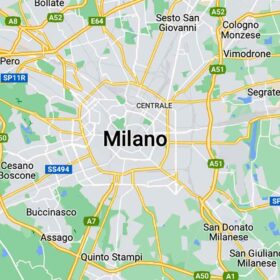
 The Geographic Location of Milan – A Strategic Spot in the Heart of Europe
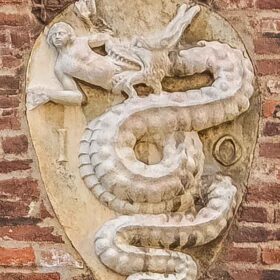 Milan’s coat of arms
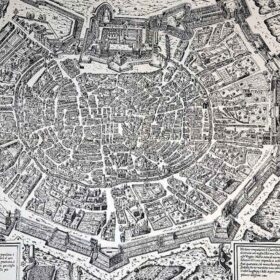 History of Milan
 Saint Ambrose
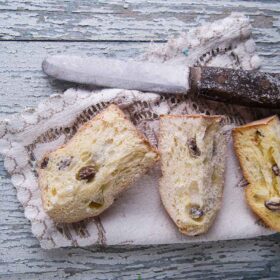 History of Panettone
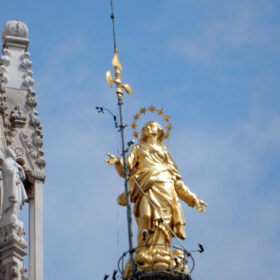 Madonnina
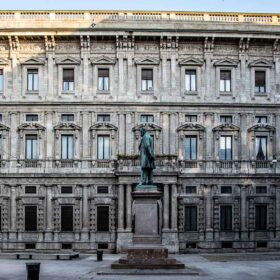 City Hall
 Milanese cuisine


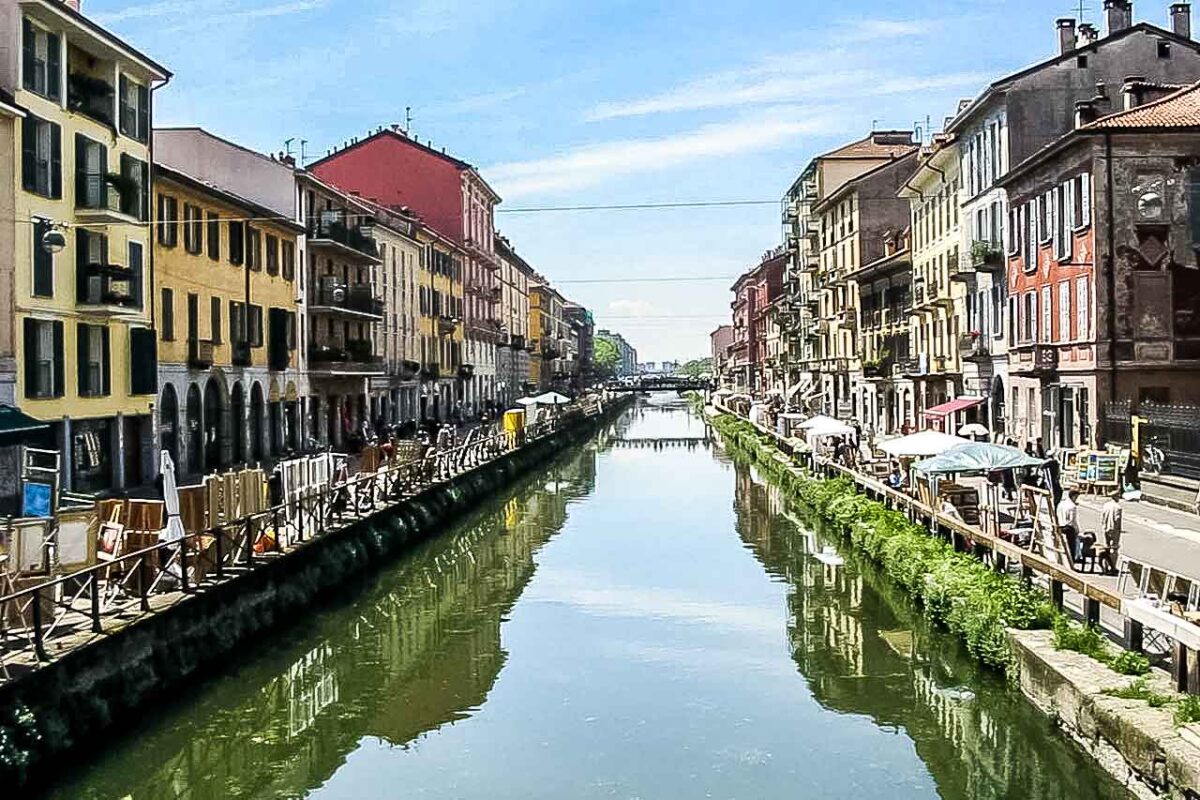
In the 1930s, Milan’s authorities made a decision that forever changed the city’s face – they filled in most of the urban canals. Today, beneath the streets and sidewalks lies what for centuries was the economic heart of the city. Only fragments remain: Naviglio Grande, Naviglio Pavese, and Darsena. But these remaining canals are enough to understand what Milan once was – a city of water, not just the fashion capital.
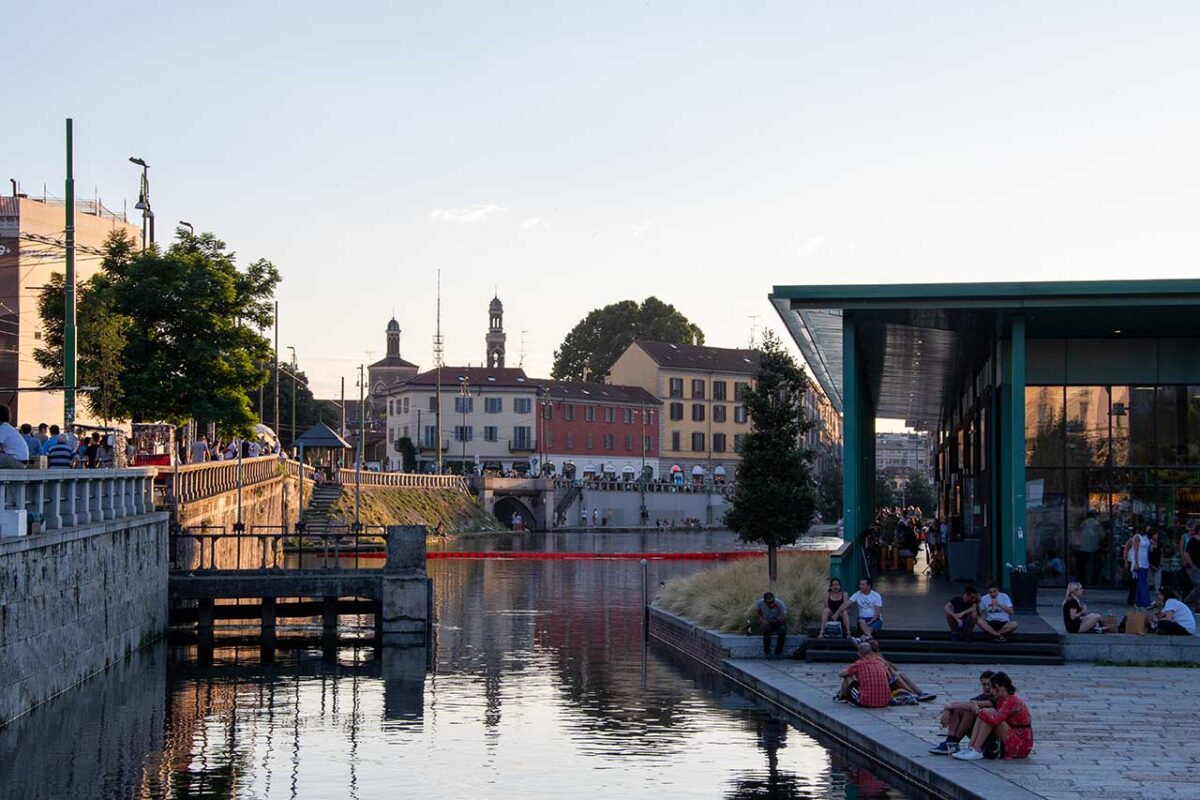
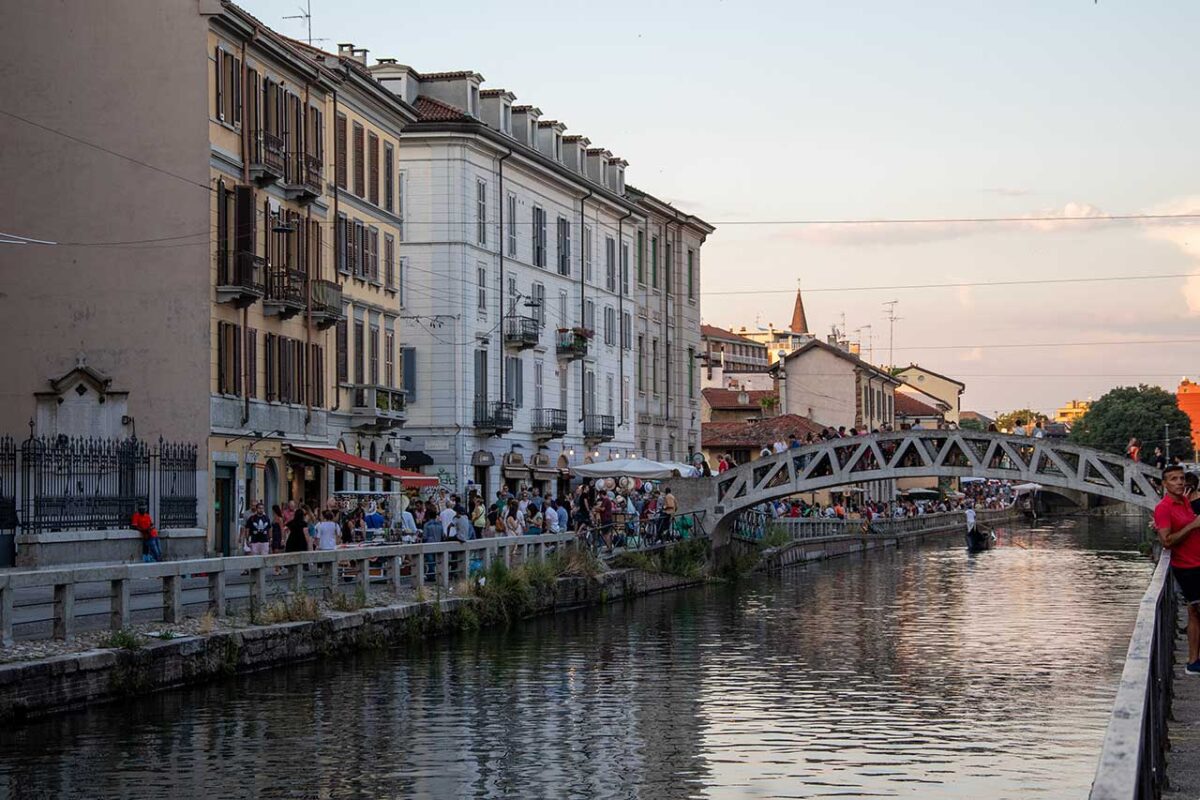
Standing on the bank at sunset, looking at the reflections of colorful townhouses in the water, it’s hard to believe the true history of this place. That marble for the Duomo was transported right here. That Leonardo da Vinci walked these paths and sketched his ideas for locks. That Milan had a river port that competed with seaside cities.
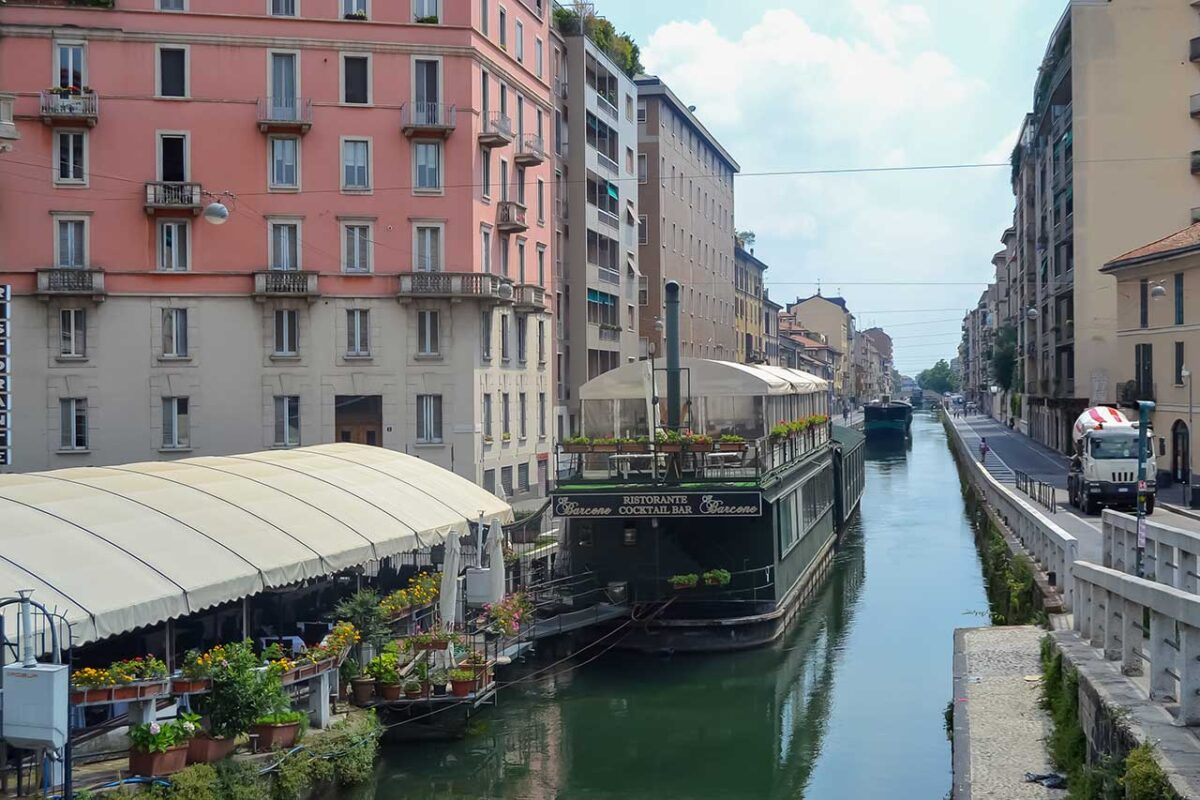
By day, the district is peaceful – you can stroll along the canal, peek into small galleries, search for hidden courtyards. In the evening, everything changes. Restaurant tables fill up with people, music drifts from bars, the air carries the scent of aperitivo. That’s when Navigli shows its true face.
Where Did the Canals in Milan Come From?
Milan isn’t located on a river. It also doesn’t have direct access to the sea. Yet for centuries, it was one of the most important inland ports in Italy. How was that possible? Thanks to a system of artificial canals that began to be built as early as the 12th century.
The first excavations had a defensive purpose – Milan needed a moat to protect it from attacks by Emperor Frederick Barbarossa. But the greater potential was quickly recognized. Monks from the nearby abbeys of Chiaravalle and Morimondo, who knew about water engineering, helped transform the marshy areas around the city into an irrigation and transportation system.
Naviglio Grande, the oldest canal, was completed in 1272. Master Giacomo Arribotti leveled the bottom and made it navigable. The canal was almost 50 kilometers long and connected Milan to the Ticino River, and through it to Lake Maggiore and further to the Po River. That meant access to the Adriatic Sea – a true trade highway of those times.
Naviglio Grande, the oldest canal, was completed in 1272. Master Giacomo Arribotti leveled the bottom and made it navigable. The canal was almost 50 kilometers long and connected Milan to the Ticino River, and through it to Lake Maggiore and further to the Po River. That meant access to the Adriatic Sea – a true trade highway of those times.
Marble for the Duomo Floated on the Canal
When construction of the Duomo cathedral began in the 14th century, a problem arose: how to transport huge blocks of marble from the Candoglia quarries to the city center? The land route was too expensive and dangerous. The solution turned out to be Naviglio Grande.
Barges loaded with pink marble floated on the canal for weeks until they reached Milan. To facilitate this transport, the authorities exempted them from all customs fees. The ships were marked with the inscription “AUF” – Ad Usum Fabricae, meaning “for the use of the construction.” And that’s where the popular Italian saying “a ufo,” which today means “for free,” comes from. Quite a trace in the language from medieval logistics, right?
This marble transport by water worked for centuries. The last delivery took place only in 1978 – less than 50 years ago. Imagine: in times when Fiat 500s were driving around Milan, marble for the Duomo’s maintenance still arrived by canal.
What Did Leonardo da Vinci Do?
We need to debunk one popular myth: Leonardo didn’t invent Milan’s canals. When he arrived in Milan in 1482, the system already existed and had been functioning for centuries. But what Leonardo did was equally important – he solved problems that had plagued engineers for decades.
The main challenge was the height differences between individual sections of the canals. How to make barges pass between them? Leonardo designed a system of locks (conche), which worked like elevators for ships. His most famous lock, Conca dell’Incoronata from 1496-1497, stands at via San Marco and still operates today, after almost 500 years.
Leonardo introduced several key improvements: gates closing at an angle (porta a doppio battente), which better withstood water pressure, stepped thresholds cushioning impacts, and mechanisms for opening sluices from the shore. Detailed sketches of these solutions are preserved in his famous Codex Atlanticus.
In his notes, Leonardo observed everything – even barges. He wrote: “The largest boats that are made are 7.5 arms wide and 42 arms long and 1.5 arms high.” That’s the pedantry of a true engineer.
When Did the Canals Disappear?
At its peak, between the 13th and 19th centuries, Milan was one of Europe’s largest inland ports. In 1953, Darsena (the urban port) ranked thirteenth among Italian ports in terms of goods received. Hard to believe, looking at today’s Milan, right?
But the era of cars came. Water transport was slow (3 km/h), while trains and trucks were fast. The canals began to hinder street traffic. The decision was made: fill them in. Work started in 1929 and lasted several years. Most canals inside the city disappeared under asphalt.
If today, while walking around Milan, you notice suspiciously wide and straight streets – you’re probably looking at former canals. The main ring road around the center is nothing other than the former Cerchia dei Navigli, the inner canal connecting the whole system.
Fortunately, fragments remain that today form the Navigli district. And that’s where it’s worth going.
Two Canals, Two Atmospheres of the Navigli District in Milan
The center of today’s district is formed by two canals flowing out from Darsena port. Though they run almost parallel, they differ like day and night.
Naviglio Grande
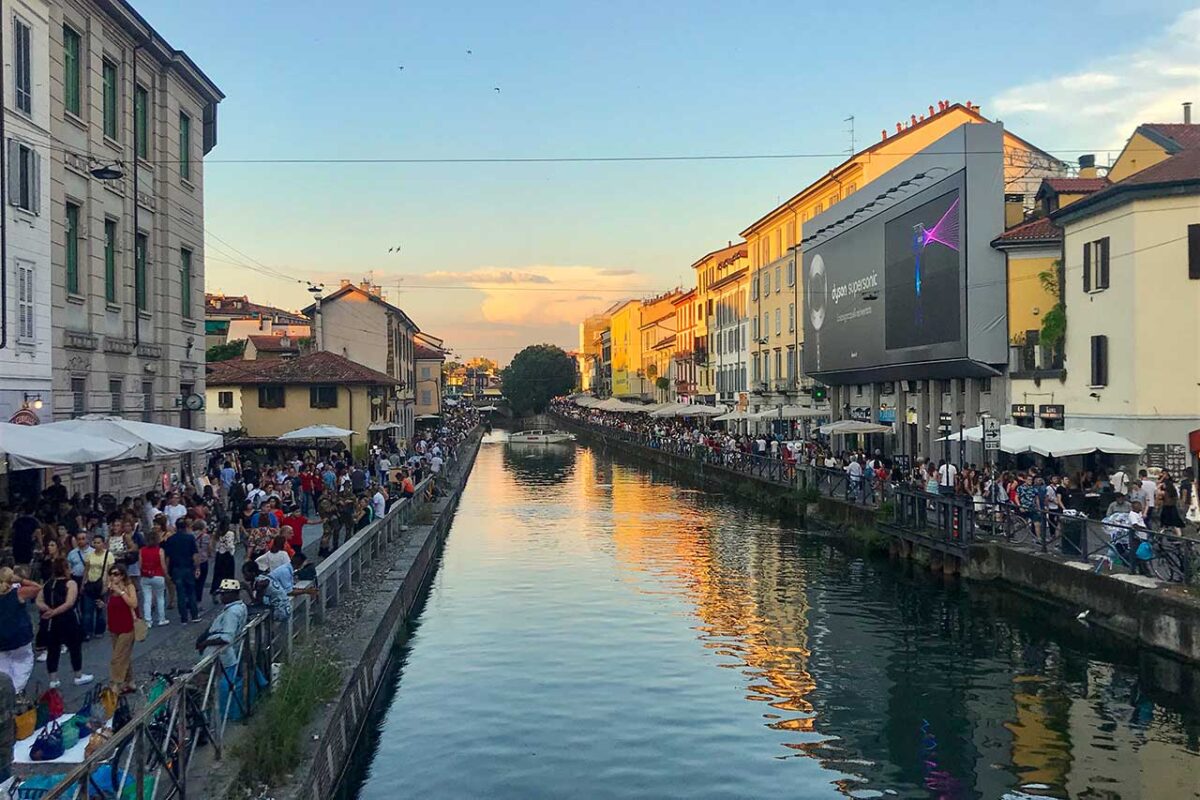
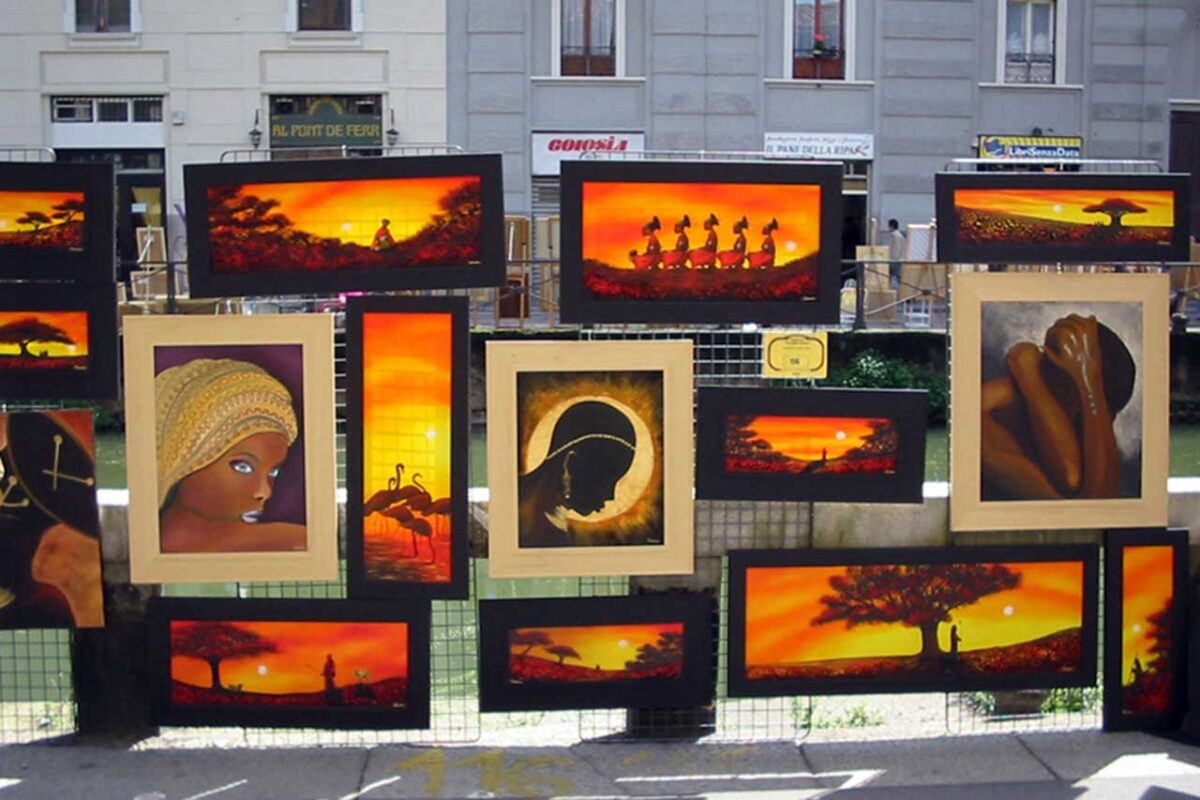
Naviglio Grande is the main party street. Almost 2 kilometers of bank lined with bars, restaurants, small shops. In the evening, it’s hard to get through – tables occupied, people standing with glasses by the edge, conversations blending into a multilingual buzz. Famous antique markets happen here (last Sunday of the month), artists sit at easels, every bar tries to outshout its neighbor with louder music.
Characteristic case di ringhiera – townhouses with gallery balconies – create a colorful scenery reflected in the water. Once these were working-class homes, today they’re some of the most desirable apartments in Milan. Ironic how times change.
Naviglio Pavese
Naviglio Pavese is a different story. Calmer, less touristy, more local. It was completed only in 1805 by Napoleon’s order and connects Milan to Pavia. Here you can actually hear your own thoughts during a walk. See the Conchetta lock designed by Leonardo, which still works after 500 years. In the old brickworks, there’s now the Mu-Mi Ecomuseum, which tells the history of the canals.
Supposedly, mascarpone was invented at Naviglio Pavese, in Borgo dei Formaggiai (the cheese district). Is it true? Hard to say, but it sounds appetizing enough to want to believe it.
Port Darsena
Darsena, where both canals meet, was the city’s trading port built in 1603. For centuries, hundreds of barges docked here daily, loading, unloading. After the war, the port declined, the canals became neglected. Only the renovation before Expo 2015 brought life back to this place. Today it’s a pleasant square with trees, benches, the Mercato Coperto market, and a view of the water.
Hidden Gems and the Best Attractions You Must See
Vicolo dei Lavandai – An Alley with History
This is my favorite place in the whole district. A small passage at Alzaia Naviglio Grande 14, where it seems like time has stopped. An original public washhouse is preserved here – a stone trough with a wooden roof, where clothes were washed until the 1950s.
And now a fun fact: why is it called “Vicolo dei Lavandai” (masculine form), not “Lavandaie” (feminine)? Because washing was a business run by men here. In the 18th century, the Brotherhood of Launderers (Confraternita dei Lavandai) was formed – a real professional guild. Men collected dirty linen from wealthy families, brought it here in baskets on their backs, washed it, and returned it clean. For money, of course.
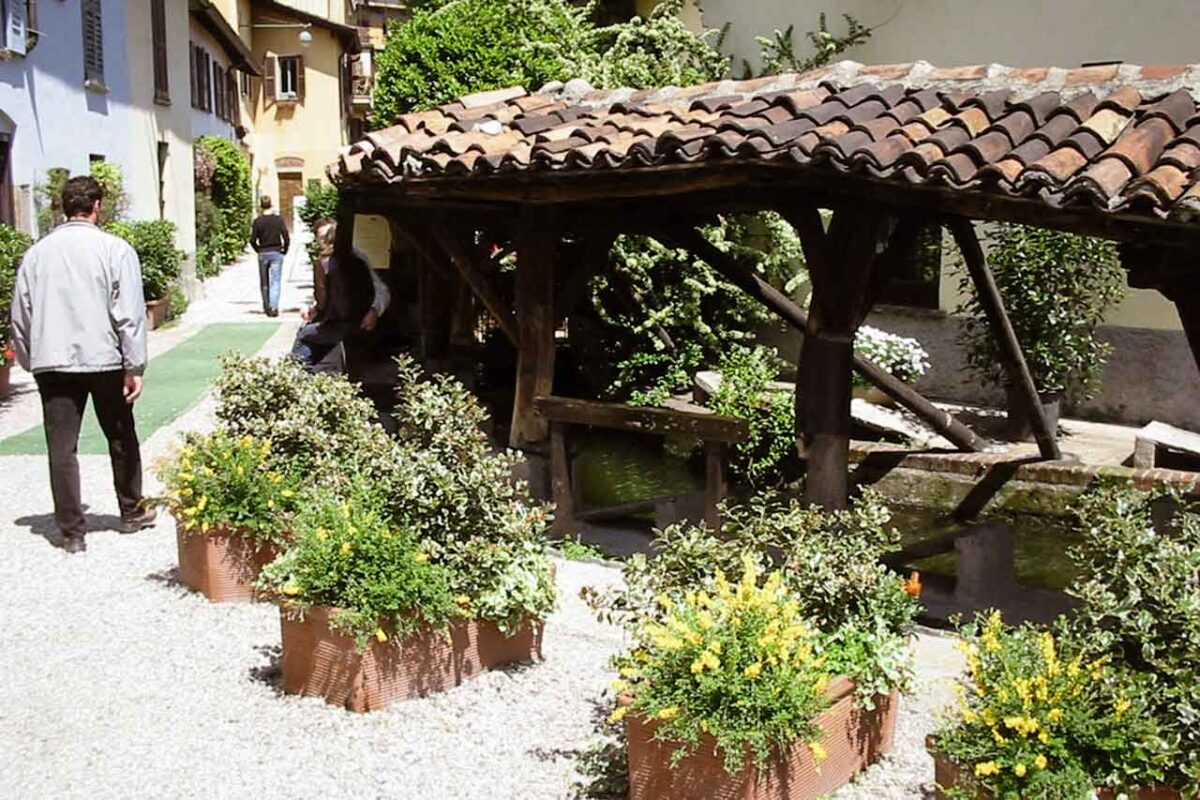
Today it’s a must-see for photographers and tourists seeking an authentic piece of old Milan.
Cortile degli Artisti – A Secret Behind the Gate
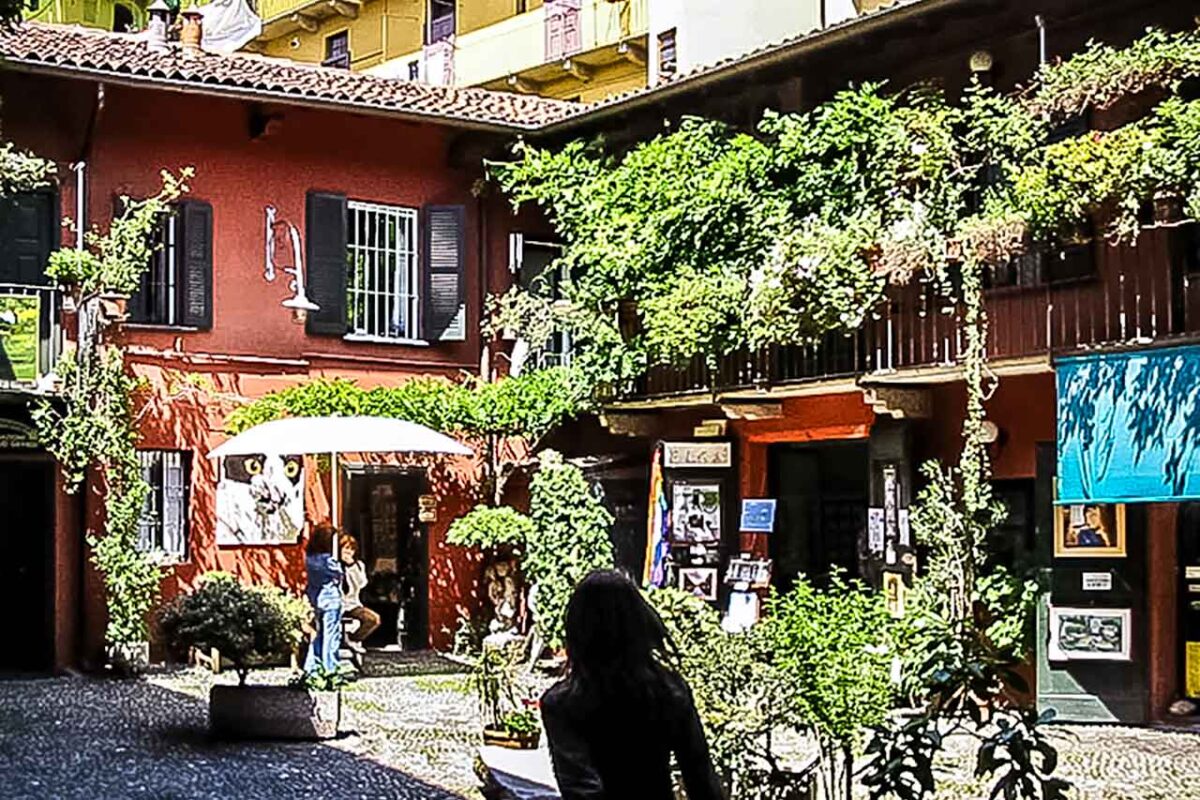
At Alzaia Naviglio Grande 4, there’s an ordinary gate in an ordinary townhouse. Go through it. Seriously, just go in. Behind the gate, you’ll discover Cortile degli Artisti – the Artists’ Courtyard. It’s a magical place full of plants, paintings, sculptures, old photographs. Someone just created a mini gallery in their backyard.
Admission is free, but one rule applies, written on a sign: “rispettare il silenzio!” – respect the silence. No phone ringing, no shouting, no noise. This place works only because people respect this simple request.
Bridges Worth Photographing
Ponte di Pietra (stone bridge) has gained a new name in recent years – local jokers from the blog “Il Milanese Imbruttito” christened it “Ponte dei Fashion Blogger.” Why? Because every evening, a line forms of people taking photos against the canal and sunset. Officially, the bridge is dedicated to poet Alda Merini, but the name “influencers’ bridge” has stuck better.
Pont de Ferr is the second characteristic bridge – iron, industrial, completely different vibe. Fewer people, more authenticity.
Churches That Have Survived Centuries
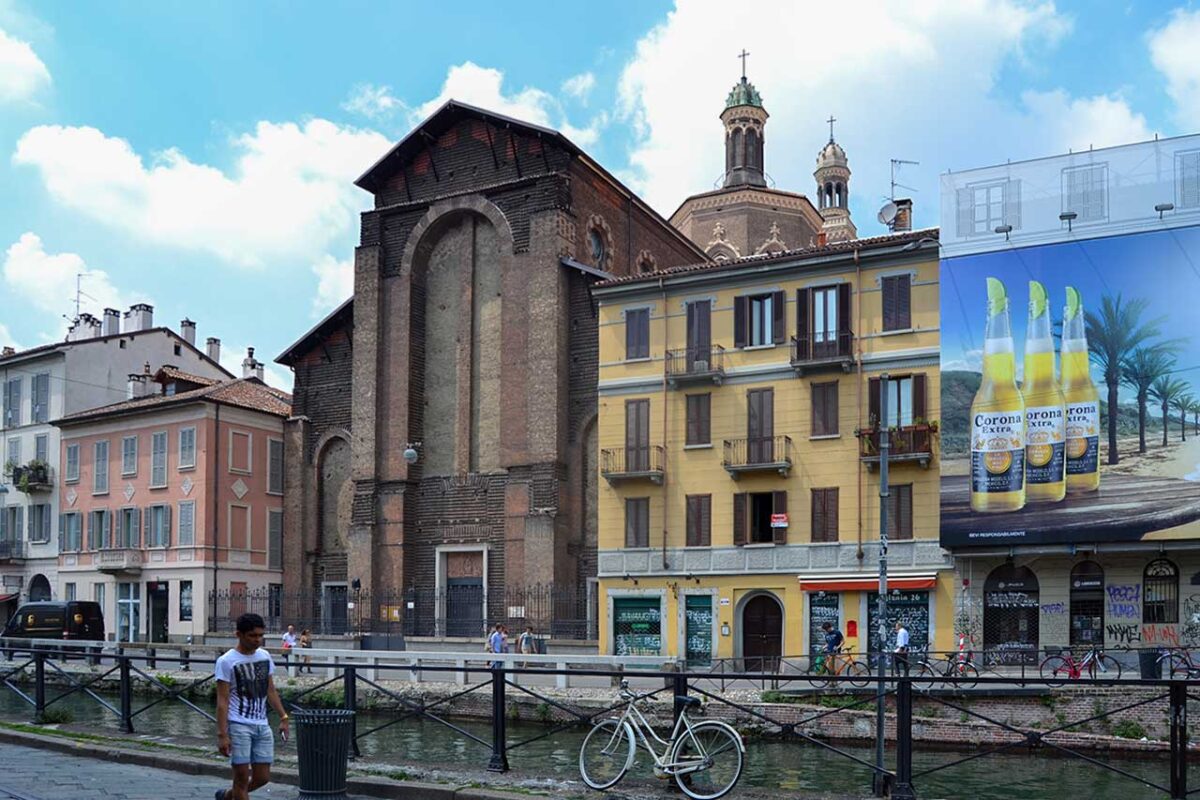
Chiesa di San Cristoforo sul Naviglio is a rarity – a complex of two connected churches, one from the 13th century, the other from the 15th. The bell tower served for centuries as a landmark for barge captains entering the city. “When you see the San Cristoforo bell tower, you’re almost there” – that’s what navigation maps of those times said.
Santa Maria delle Grazie al Naviglio has a sad history. Construction began in the 19th century with great fanfare, but the money ran out. The facade was never completed. The church stands to this day with a raw, unfinished exterior wall. Sometimes imperfection is more interesting than perfection.
The Modern Face of the Milano Navigli District
Right next to Navigli stretches Tortona a district that turned from post-industrial warehouses into a design center. During Milan Design Week (in April), this is where the most interesting things happen.
MUDEC (Museum of Cultures) is a modern exhibition space showing art from around the world. Changing exhibitions, lots of light, interesting architecture.
Armani Silos is an elegant museum dedicated to Giorgio Armani’s work. Four floors of fashion in an old grain silo – 600 outfits from 40 years of the designer’s career.
BASE Milano occupies a former Ansaldo factory. Now it’s a center for alternative culture – exhibitions, workshops, concerts, film screenings. Check the program before visiting, because something’s always happening there.
Street Art at Every Step
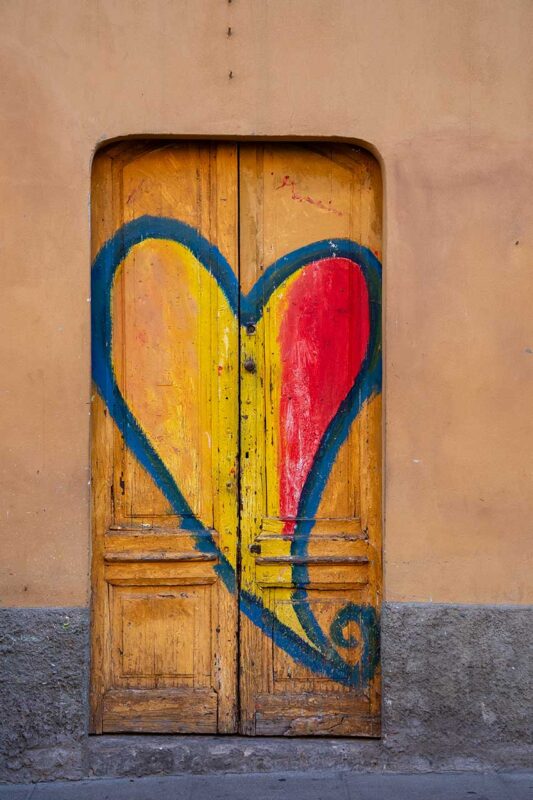
The walls along the canals have become a canvas for street artists. You don’t have to look specially – just walk and look, most interesting murals can be spotted on your own.
On Via Conchetta, you’ll find the glowing-in-the-dark mural by Orticanoodles “
Music is a Neverending Journey.
” Along Naviglio Pavese, look for the three-dimensional shark by Marco Teatro “
Lo Squalo
,” which looks like it’s emerging from the water. Under the Ponte Guido Crepax bridge, the We Run the Streets collective painted a triptych inspired by the Divine Comedy – Hell, Purgatory, Paradise on three walls.
For poetry fans, there’s Spazio Alda Merini, dedicated to the “Poet of Navigli.” Inside, her real bedroom is recreated with original furniture and personal items. Very personal, very moving.
Where to Eat in Navigli – From Aperitivo to Fine Dining
Navigli isn’t just canals and history. It’s one of the best places in Milan for eating – from cheap street food to Michelin-starred restaurants. Everyone will find something here, regardless of budget and mood.
Aperitivo – A Ritual You Can’t Miss
If you want to understand Milan, you have to try aperitivo. It’s not just a drink before dinner. It’s a social ritual, the moment when the city leaves offices and meets by the water.
The rule is simple: you pay for a drink (10-15 euros), you get access to a buffet with varying snacks. Some bars offer cold appetizers, others hot dishes. In the best places, the buffet is so abundant that it easily replaces dinner.
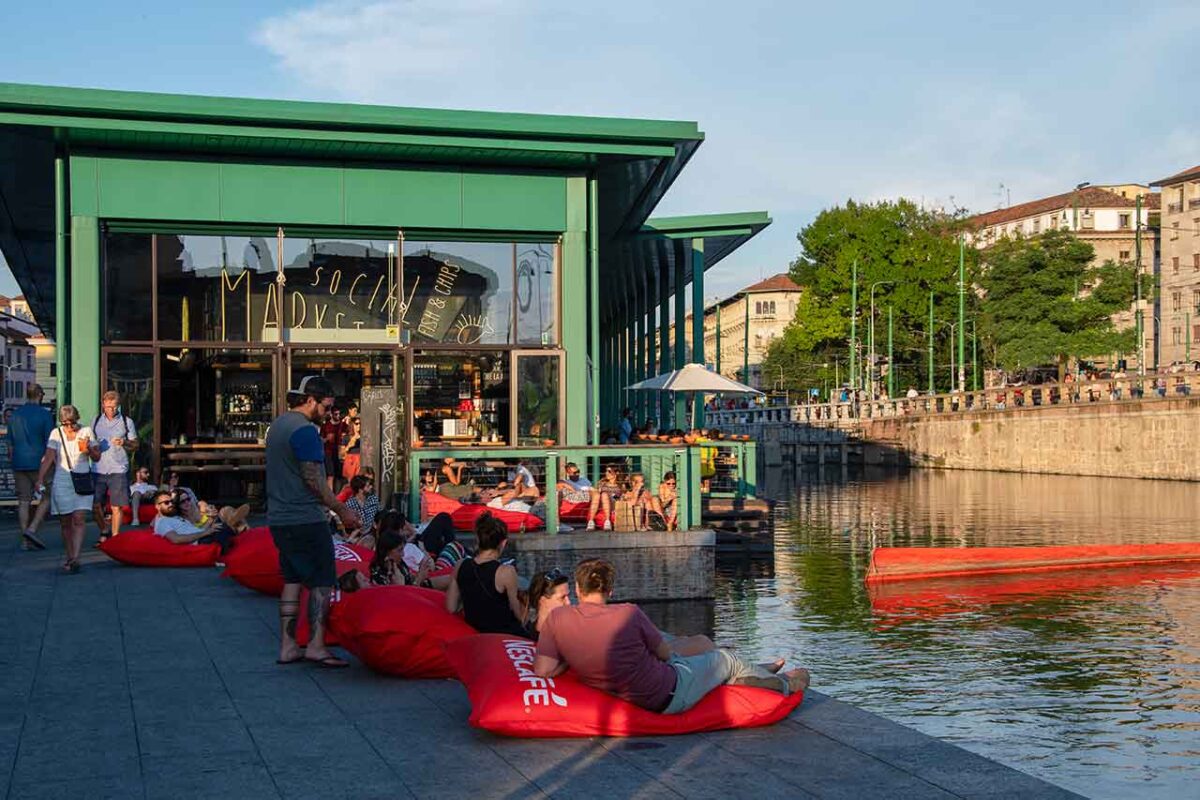
Navigli is the epicenter of it all. Around 5:00-7:00 PM, the canal banks fill with people. Tables are taken in seconds, so either reserve in advance or prepare to stand with a drink by the edge. Which isn’t bad at all – the best atmosphere is right there, where the most people are milling about.
But watch out for the trap: walking along Naviglio Grande, you’ll encounter buttadentro – hawkers standing in front of bars who will try to pull you inside. “Please, please, best aperitivo, come see!” – that’s their standard line. Don’t get caught by the first offer.
My advice? Stroll, observe. See where Milanese sit, not tourists. Listen to the language – if you hear more Italian than English, it’s a good sign. Avoid places with big posters “APERITIVO 10 EURO” stuck out in the middle of the sidewalk. The best bars don’t need to advertise like that.
As for aperitivo bars, Mag Café on Ripa di Porta Ticinese 43 is a place through which half of Milan passes. The bar is decorated like an old pharmacy, full of vintage knick-knacks and signature cocktails for 9-10 euros. The menu changes every few months – once inspired by fairy tales, another time by cinema. Snacks are served with the drink. Popular spot, so either come early or reserve. In summer, the garden with a canal view bursts at the seams.
The same family runs BackDoor43 – a tiny bar that fits a maximum of four people. But you don’t have to fight for a seat – they make cocktails to go. You buy, go to the canal, drink. Simple. Plus, they create drinks to order, according to your taste.
Rita is a modern bar with stiff cocktails. If you like spicy notes, order “Chili Martini.” They also serve small pizzas and focacce – something to eat with your drink.
Traditional Milanese Cuisine
El Brellin in Vicolo dei Lavandai is an absolute icon. The name comes from the wooden kneeler on which washerwomen washed clothes. A place with wooden beams, fireplaces, and an authentic atmosphere of old Milan. On the menu, classics: risotto alla milanese, ossobuco in gremolata, rustin negàa (pork chops in butter and sage), riso al salto (risotto fried in a pan). Prices aren’t the lowest, it’s not an ordinary osteria, but the atmosphere and location are unique. In summer, the garden fills to the brim.

Trattoria Madonnina – an authentic, family trattoria with a menu full of Lombard specialties: gnocchi di patate, brasato (braised beef), cotoletta (real Milanese pork chop with bone). Reasonable prices (20-40 euros), warm atmosphere, a place where locals eat.
Ponte Rosso na Ripa di Porta Ticinese – a small, intimate trattoria with a typical vibe. Great traditional dishes, friendly service. This is the place for those seeking authenticity without tourist traps.
Trattoria Bolognese da Mauro opened in 1969. They specialize in Emilian cuisine: fresh pasta made on an old crank machine, tortellini, tagliatelle, lasagne. If you miss a real Italian grandma cooking, this is the spot.
Innovative Cuisine and Fine Dining
28 Posti at Via Corsico 1 is a restaurant with a limited number of seats and zero-waste cuisine. Chef Franco Salvatore (who worked for 7 years with previous chef Marco Ambrosino) runs the place with Andrea Zazzara since 2022. Creative cuisine, degustation menu “alla cieca” (blind) – you don’t know what you’ll get until they bring it. Reserve well in advance, seats disappear quickly. In summer, you can eat outside.
Contraste (Via Giuseppe Meda) with a Michelin star, here chef Matias Perdomo doesn’t have a standard menu. Instead, you get one of two degustation menus tailored to your preferences: “Riflesso” (more traditional) or “Riflessioni” (avant-garde). You talk, say what you like, what you don’t eat, and the kitchen creates a menu just for you. The restaurant underwent renovation in 2024. Pizza and Street Food
Pizza and street food
Pizzium is a pizzeria with high-quality ingredients and unusual combinations. Close to Navigli, reasonable prices. A good option when you care about quality without spending a fortune.
Meatball Family (Via Vigevano 20) is an industrial spot in New York style, specializing in meatballs. The menu has hundreds of variants – from classic to experimental. They also have burgers and pizza, but meatballs are their specialty.
International Cuisine
Temakinho (Ripa di Porta Ticinese 37) -Japanese-Brazilian fusion. Tropical atmosphere, colorful decor with lots of greenery. Uramaki with exotic combinations (tuna with mango, shiitake mushrooms), cocktails like Sakerinha (caipirinha with sake). Reasonable prices: 11-15 euros for 8 rolls. They also have locations near Duomo and in Brera.
Tenoha & Ramen (Via Vigevano 20) – a spot specializing in ramen and Japanese cuisine. Open only for dinner (7:00-11:00 PM), closed on Tuesdays. This place replaced the multifunctional space Tenoha Milano, which ended operations after 8 years. Now a simpler concept – focus on Japanese soups and traditional dishes.
Ice Cream, When You Crave Something Sweet After Dinner
Gelateria della Musica – one of the best ice cream shops in Milan. They specialize in pistachios, especially the famous pistacchio salato. Flavors change seasonally – summer fruits, winter chocolates and nuts. Fun fact: each flavor has a name of a song or artist. Locations: Via Lodovico Il Moro 3, Via Pestalozzi 4, Piazzale Francesco Baracca 10.
Gelateria Latteneve (Via Vigevano 27) – artisanal ice cream without preservatives. Run by Carlo Lanzoni, a former manager. Offerings include pistacchio di Bronte with salt and pepper, vegan ice cream with “Vegan OK” certification. In winter, hot chocolate, in summer granita. They also have crêpes with Nutella, pistachios, or almond cream.
Gusto 17 (Via Savona 17) – distinguished by Gambero Rosso in the “Gelateria d’Italia” guide. Ice cream from fresh seasonal fruits, famous pistacchio di Bronte. Premium prices, but gourmet quality. Awards: Forbes Italia 100 eccellenze, Food and Travel Italia Awards 2022. They also have locations at Via Cagnola 10 and in La Rinascente.
Mercato Coperto della Darsena
Don’t miss the covered market at Darsena. Restored before Expo 2015, now it’s a paradise for foodies. Exotic spices from around the world, traditional Milanese products, fresh cold cuts from butchers, bakeries with warm bread, ethnic souvenirs. Open on weekdays and Saturdays. Perfect spot for morning shopping to make a picnic by the canal.
Practical Tips on Eating in Navigli
Prices in Navigli are higher than in other districts – it’s a tourist zone, so you have to expect that. Aperitivo 10-15 euros, pizza 10-15 euros, dinner in a trattoria 25-40 euros per person, fine dining 80-150 euros for a degustation menu.
Reserve in advance, especially on weekends. On Friday and Saturday evenings, without a reservation, you might spend an hour looking for a free table. Most restaurants accept reservations through The Fork or by phone.
Don’t get pulled in by hawkers, you already saw about that with aperitivo, but it applies to restaurants too. If someone stands in front of the place and actively tries to lure you, it usually means the spot isn’t good enough for people to come on their own.
Cruises and Other Water Activities
The best way to understand the history of the canals? See them from the water’s perspective, just like merchants and captains saw them for centuries.
Boat Cruise
Boat cruises (battello) last about an hour and go through the most important points: the 13th-century San Cristoforo church, Vicolo dei Lavandai, Darsena, up to the Conchetta lock. On board, there’s an audio guide (in Italian and English) that tells the history of the places passed. Evening cruises offer aperitivo on the water – a drink in hand, sunset, reflections of lights. Prices 19-29 euros, reservations through navigami.com.
SUP
If you prefer something more active, try stand-up
paddleboarding (SUP)
. Organized tours are available, best at sunrise or sunset when there’s less traffic on the canals. It’s a completely different experience – you stand on the board, glide on the water in silence, passing the same places as barges 500 years ago.
And if you want to feel like in Venice? You can ride a gondola on Darsena. It’s led by Umberto, a friendly gondolier who will tell you anecdotes about the canals. It’s a bit touristy, but who said tourism has to be bad?
Events and Markets – The District’s Calendar
Fiera di Sinigallia happens every Saturday at Ripa di Porta Ticinese. It’s the oldest flea market in Milan, full of treasures for vintage collectors. Locals come here, not tourists. You can find old vinyl records, 1960s furniture, second-hand clothes, books, lamps, everything. Come early, because the best things go fast.
Mercatone dell’Antiquariato is a whole different league. Last Sunday of every month, the entire Naviglio Grande turns into a huge antique market. Hundreds of stalls, professional dealers, collectors from all over Italy. Here it’s not about finding cheap deals – more about admiring beautiful things and maybe buying something special if the budget allows.
In spring and fall, themed festivals are organized: “Fiori e Sapori sul Naviglio Grande” (flowers and flavors) and “Arte sul Naviglio Grande” (art). Exact dates change every year, so check the calendar before your trip.
How to Get There and When to Come
The simplest way is the metro – line M2 (green) to Porta Genova station. Exit the station, walk straight about 5 minutes, and you’re at Darsena. Alternatively, trams 2, 3, 9, or 10. From the center, it’ll take you about half an hour.
The district “works” all year round, but the best times to visit are spring and fall – pleasant temperatures, you can sit outside without freezing or sweating. In summer, it can be hot and crowded, in winter cold and a bit empty.
As for time of day: mornings and afternoons the district is calm, few people, only some bars open. Good time for sightseeing, taking photos without crowds, peeking into galleries. In the afternoon, movement starts – shops open, first guests appear. In the evening (from 5:00 PM), the district fills up. Aperitivo, dinners, nightlife. If you like crowds and atmosphere, that’s your time. If you prefer peace, come in the morning.
Where to Stay in Navigli and Is It Worth It?
Navigli is one of the most sought-after districts for accommodation in Milan. It combines the vibe of the old city with the energy of a modern neighborhood. But is it really worth staying here? It depends on what you’re looking for and how deeply you sleep.
Who Is It Good For?
Navigli is ideal if you like being in the middle of the action. You step out of the hotel and you’re right by the canal, with aperitivo around the corner. The district attracts young people, artists, students, designers. It’s Milan’s bohemia, not a sterile business center.
If you plan to spend evenings among locals and don’t want to waste time on commutes – this is your place. You have everything at hand.
On the other hand, if you need silence to sleep – think twice. Weekend evenings can be noisy. The buzz from bars sometimes lasts late. If you’re a light sleeper, it might be a problem.
Parking? Forget about the car. ZTL zone, few spots, expensive multi-level parking lots. If you’re coming by car, leave it somewhere else and use public transport.
Prices? Prices? Higher than the city average. You pay for the location.
What’s Available? Hotels, Apartments, Residences
Hotele boutique – e.g., Maison Borella right on Naviglio Grande. Historic building, contemporary comfort. Well-rated.
Modern concepts – Combo is a mix of hostel, bistro, cafe, and co-working in an old casa di ringhiera. Green surroundings, young clientele. Or 21 House of Stories Navigli at Via Ascanio Sforza 7 – rooms, bistro, work space. For digital nomads.
Apartments – plenty of options on Booking.com and Airbnb. Often in restored townhouses. Good for families or longer stays. Prices 80-150 euros per night, depending on standard.
Student residences – because Bocconi and IULM universities are nearby. Cheaper rooms, but more spartan.
Pros and Cons in Brief
Practical Tips
When looking for a hotel, check the room’s exact location. Ask if it overlooks the canal or a quieter back side. Rooms from the courtyard or higher floors are quieter, but you lose the view.
Read reviews on Booking.com, especially sections about noise. People write honestly.
If it’s your first visit to Milan and you plan mainly sightseeing – maybe better to stay closer to Duomo or Brera. Navigli is a great option for a second stay, when you want to get to know the less touristy side of the city. Or if you’re a night owl and love nightlife – then you’ve hit the jackpot.
A Few Facts That Will Surprise You
Navigli – Worth It or Not?
Definitely worth it. It’s one of the few places in Milan where you feel the authentic vibe of the old city. Where you can actually see what Milan looked like before glass skyscrapers and shopping centers.
The best advice? Come twice – once during the day to explore peacefully, see Vicolo dei Lavandai, look for street art, peek into galleries. And a second time in the evening for aperitivo, to feel the energy of the place where half of Milan meets.
Don’t stick to a rigid plan. Navigli is a district for wandering. Veer off the main path, enter a side street, peek behind a gate, sit on a wall and just observe. This place will tell you its own story – you just have to give it a chance.



I lived in Milan for 18 years, and it was there that I came to know the city’s daily life best - not just its landmarks, but also its rhythm, its habits, and its less obvious sides. Today I live in Wrocław, but I still return to Milan regularly.