


 The Geographic Location of Milan – A Strategic Spot in the Heart of Europe
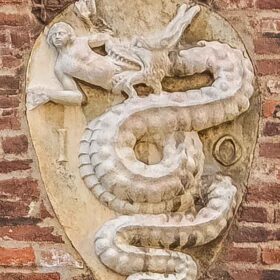 Milan’s coat of arms
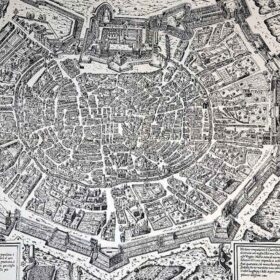 History of Milan
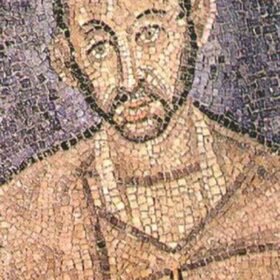 Saint Ambrose
 History of Panettone
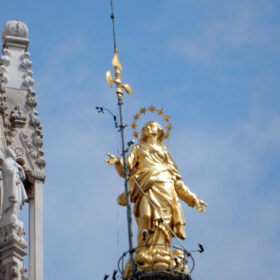 Madonnina
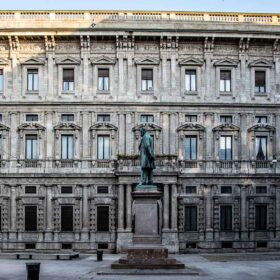 City Hall
 Milanese cuisine


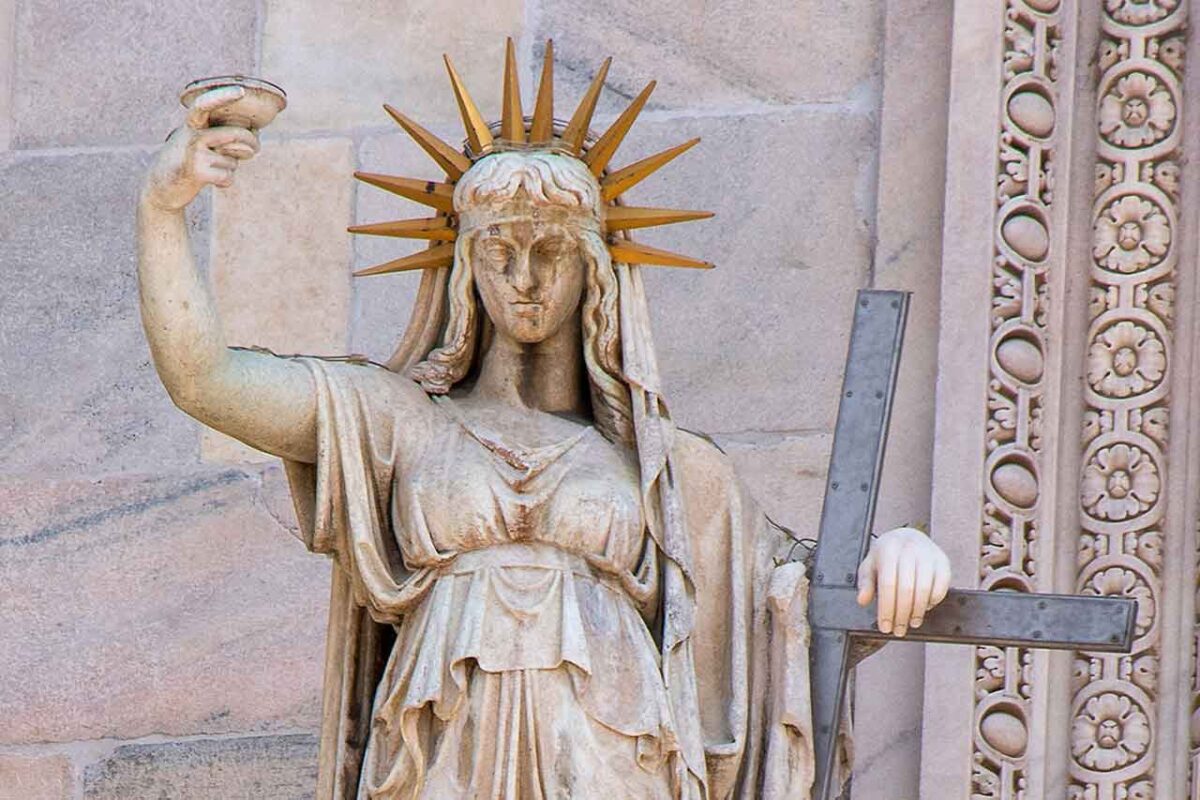
Before you step into the Duomo, do one thing first: stand in front of the main portal and look up. Right above it, on the balcony to the left, stands a sculpture that thousands of tourists pass every day without realizing they may be looking at a possible inspiration for one of the most recognizable monuments in the world.
People in Milan like to say, “If something doesn’t exist in Milan, then it doesn’t exist at all.” Apparently, they mean the Statue of Liberty too.
La Legge Nuova, a sculpture created in 1810 by Camillo Pacetti on the facade of the Duomo, is considered one of the most likely sources of inspiration for New York’s Statue of Liberty.

New Law and Old Law: what will you see on the balcony?
On the balcony above the main entrance to the Duomo stand two sculptures: La Legge Nuova (New Law) on the left and La Legge Vecchia (Old Law) on the right.
La Legge Nuova (New Law) was sculpted in 1810 by Camillo Pacetti, an artist born in Rome but, as people in Milan like to say, “adopted” by the city. He worked here at the turn of the 18th and 19th centuries, leaving his mark not only on the cathedral but also on the decoration of the Arco della Pace. To its right stands La Legge Vecchia (Old Law), the work of another sculptor, Luigi Acquisti, also from 1810.
La Legge Nuova is dressed in a Greek tunic and wears a star-crowned diadem on her head. Her right hand is raised with a torch, while her left rests on a cross. There are several similarities with her famous New York counterpart: the torch, the crown, the tunic. New York’s Statue of Liberty holds tablets in her left hand – but that is where her neighbor on the balcony comes in: La Legge Vecchia is the one holding tablets.
La Legge Vecchia (Old Law), sculpted by Luigi Acquisti in 1810, stands on the right. The figure is dressed in a Roman toga and holds the two tablets of the Ten Commandments – a detail that inevitably brings the Statue of Liberty to mind. Placed alongside the sculpture on the opposite side, the pairing takes on an even clearer meaning, referring to the passage from the Old Law to the New Law.
 La Legge Nuova (New Law)
- The Statue of Liberty in New York
- La Legge Vecchia (Old Law)
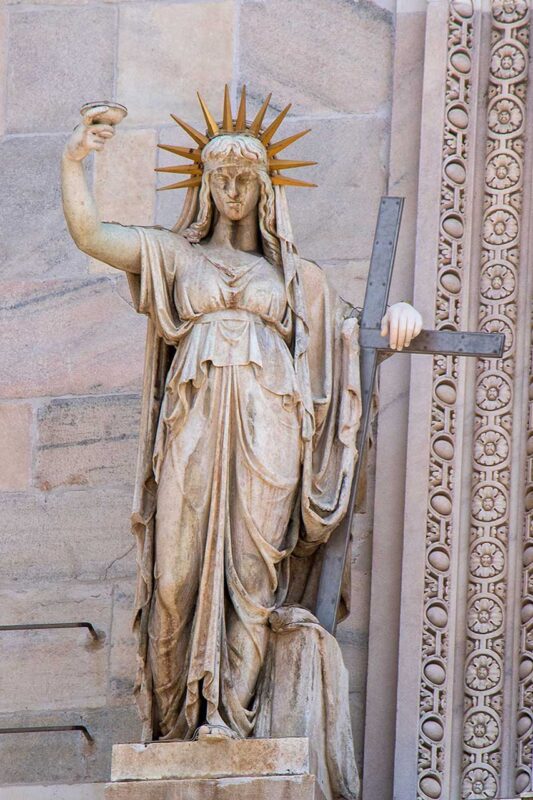
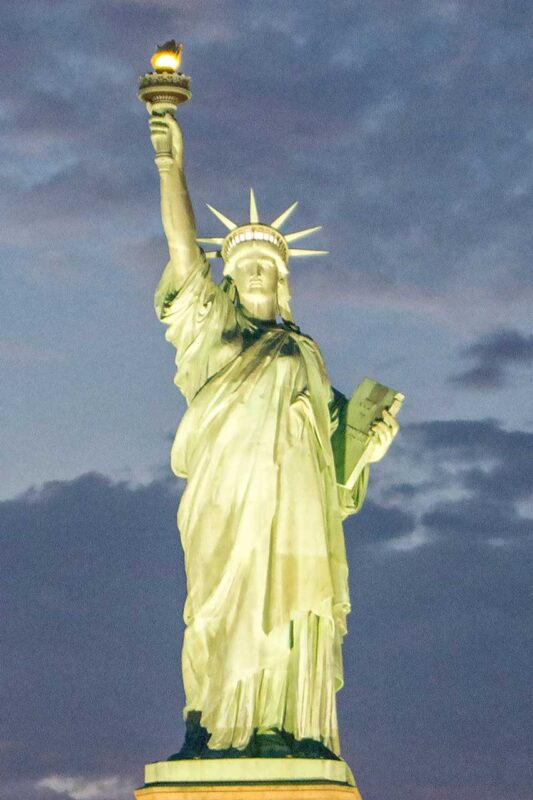
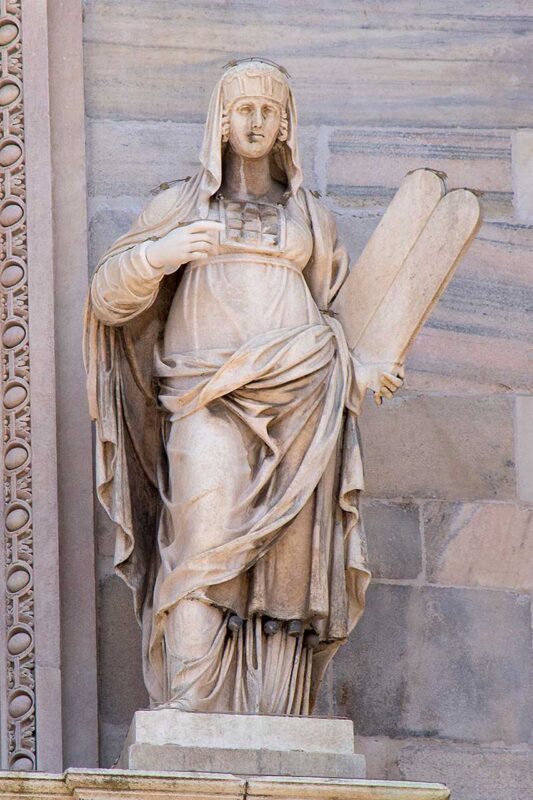

Practical tip: Look up before entering the cathedral – the sculptures are visible to the naked eye above the main portal. La Legge Nuova is on the left side of the balcony (when facing the facade), La Legge Vecchia is on the right.
Did Bartholdi see Pacetti’s sculpture?
There is no direct proof that Frédéric Auguste Bartholdi saw La Legge Nuova, but Pacetti’s sculpture predates the New York monument by more than 70 years.
Pacetti became locally known as a portraitist and as the creator of busts of Napoleon and Marie Louise, but he never achieved the international prominence to which Bartholdi directed his ambitions. So the French sculptor could, diplomatically speaking, have taken inspiration from the Italian artist’s work without risking being accused of it.
The matter is not that simple, however. The theory of a Milanese prototype is only one of several. The French point to the Colossus of Rhodes, Tuscans point to Pio Fedi’s Statue of the Liberty of Poetry from 1870-1883, placed in the Basilica of Santa Croce in Florence and in fact modeled directly on Pacetti’s work. The director of the Tate Gallery in London, in turn, pointed to a Delacroix painting from 1830. Bartholdi himself never admitted to any specific source of inspiration.
The facts that support Milan are these: La Legge Nuova was created in 1810 – more than 70 years before the unveiling of the New York monument in 1886. The torch, the crown, the raised arm, the Greek tunic – the list of similarities is long. And the bozzetto (clay model) of Pacetti’s sculpture, measuring 50 cm in height, can still be seen today at the Galleria d’Arte Moderna in Milan.
Where can you see all of this?
You can read more in external sources:
I lived in Milan for 18 years, and it was there that I came to know the city’s daily life best - not just its landmarks, but also its rhythm, its habits, and its less obvious sides. Today I live in Wrocław, but I still return to Milan regularly.